Questions surrounding the Quad’s future, Pg9
US policy shift and funding shortfalls cast doubt on Quad's future, prompting scrutiny of its security focus and commitment to countering China in the Indo-Pacific.
Practice MCQs
819 Students attempted
Key Highlights:
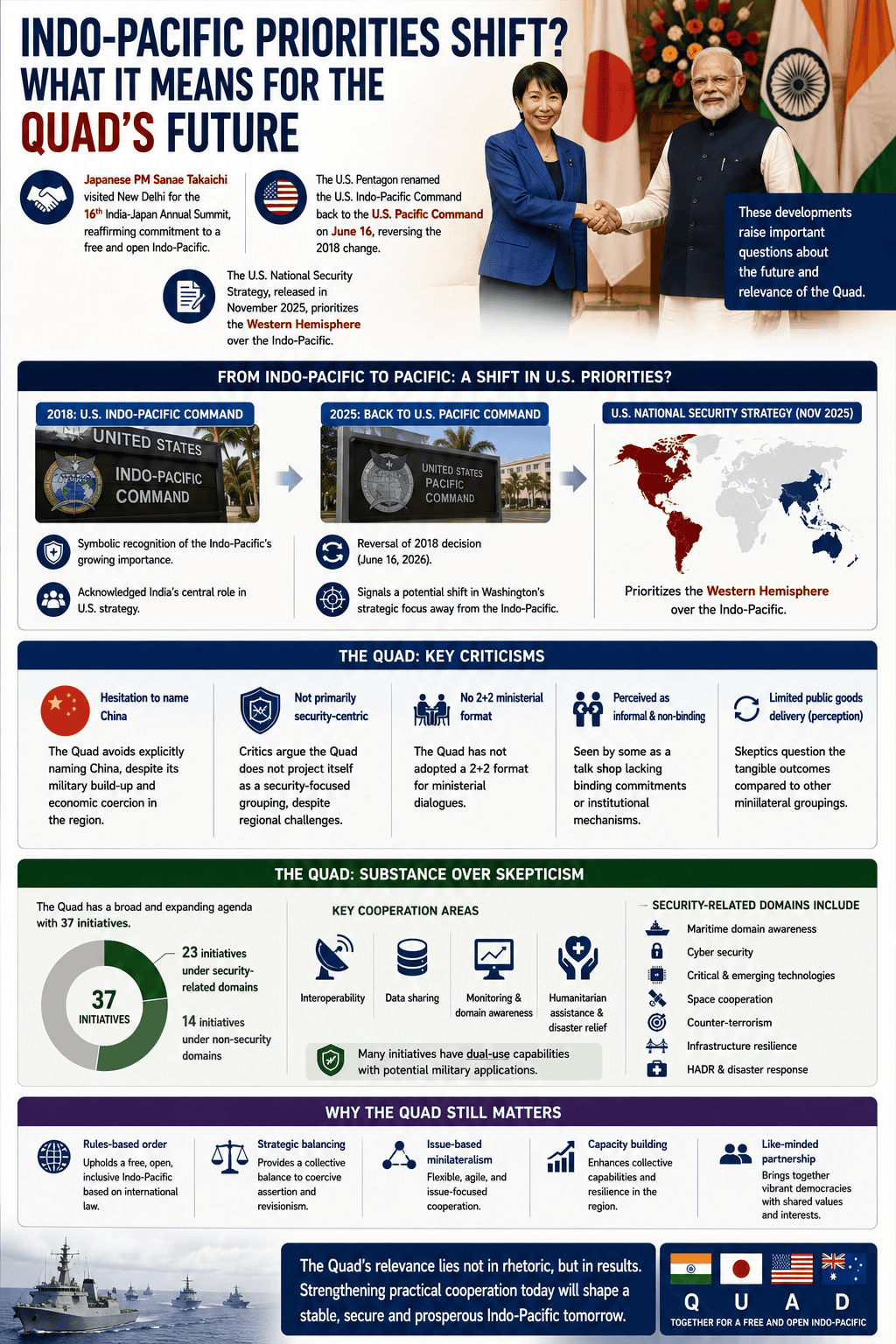
- Japanese Prime Minister Sanae Takaichi visited New Delhi for the 16th India-Japan Annual Summit, reaffirming commitment to a free and open Indo-Pacific.
- The U.S. Pentagon renamed the U.S. Indo-Pacific Command back to the U.S. Pacific Command on June 16, reversing a 2018 change.
- The U.S. National Security Strategy, released in November 2025, prioritizes the Western Hemisphere over the Indo-Pacific.
- These developments have led to questions regarding the future and relevance of the Quad.
Quad Future.png
Detailed Insights:
- The 2018 renaming to U.S. Indo-Pacific Command was symbolic, recognizing the region's growing importance and India's central role in U.S. strategy.
- The recent reversal suggests a potential shift in Washington's strategic priorities away from the Indo-Pacific.
- Critics highlight the Quad's hesitation to explicitly name China, despite its military and economic aggression in the region.
- Another criticism is the Quad's reluctance to project itself as a primarily security-centric grouping, despite regional security challenges.
- The Quad has not adopted a 2+2 format for ministerial dialogues, unlike bilateral arrangements among its member countries.
- Despite criticisms, the Quad's agenda includes 37 initiatives, with 23 falling under security-related domains.
- Cooperation areas focus on interoperability, data sharing, monitoring, and relief, with dual-use capabilities for military applications.
- The Quad emphasizes building capacity and resilient supply chains, particularly in critical and emerging technologies.
- There is a discrepancy between the Quad's security-heavy agenda and its funding patterns, with health and climate being primary beneficiaries.
- The Critical Minerals Initiative and Framework aims to mobilize $20 billion, but this target currently lacks committed or allocated funding.
Key Concepts Involved:
- Quad (Quadrilateral Security Dialogue): An informal strategic forum comprising India, Japan, Australia, and the United States.
- Indo-Pacific: A geopolitical concept encompassing the Indian Ocean and the Pacific Ocean, emphasizing their interconnectedness.
- 2+2 format: A bilateral ministerial dialogue involving the Foreign and Defence Ministers of two countries.
- Critical Minerals Initiative and Framework: A Quad initiative aimed at securing supply chains for critical minerals essential for modern technologies.

SuperKalam is your personal mentor for UPSC preparation, guiding you at every step of the exam journey.
Download the App


STUDY RESOURCES
CONTACT US
ⓒ Snapstack Technologies Private Limited