UN's Guterres warns AI outpacing oversight, urges global rules to protect children, Pg14
UN Secretary-General Guterres warns AI development outpaces oversight, urging global rules and an 'AI Child Safety Pledge' to mitigate risks.
Practice MCQs
819 Students attempted
Key Highlights:
- UN Secretary-General Antonio Guterres warned that Artificial Intelligence (AI) development is outpacing oversight, urging globally harmonized rules.
- The warning was issued at the first-ever government-level UN Global Dialogue on AI in Geneva.
- Guterres specifically called for prioritizing child safety in AI governance, citing risks like self-harm and deception.
- An independent scientific panel reported that the US accounts for 73% of computing power among the top 500 AI supercomputers, and China 16%.
UN AI.png
Detailed Insights:
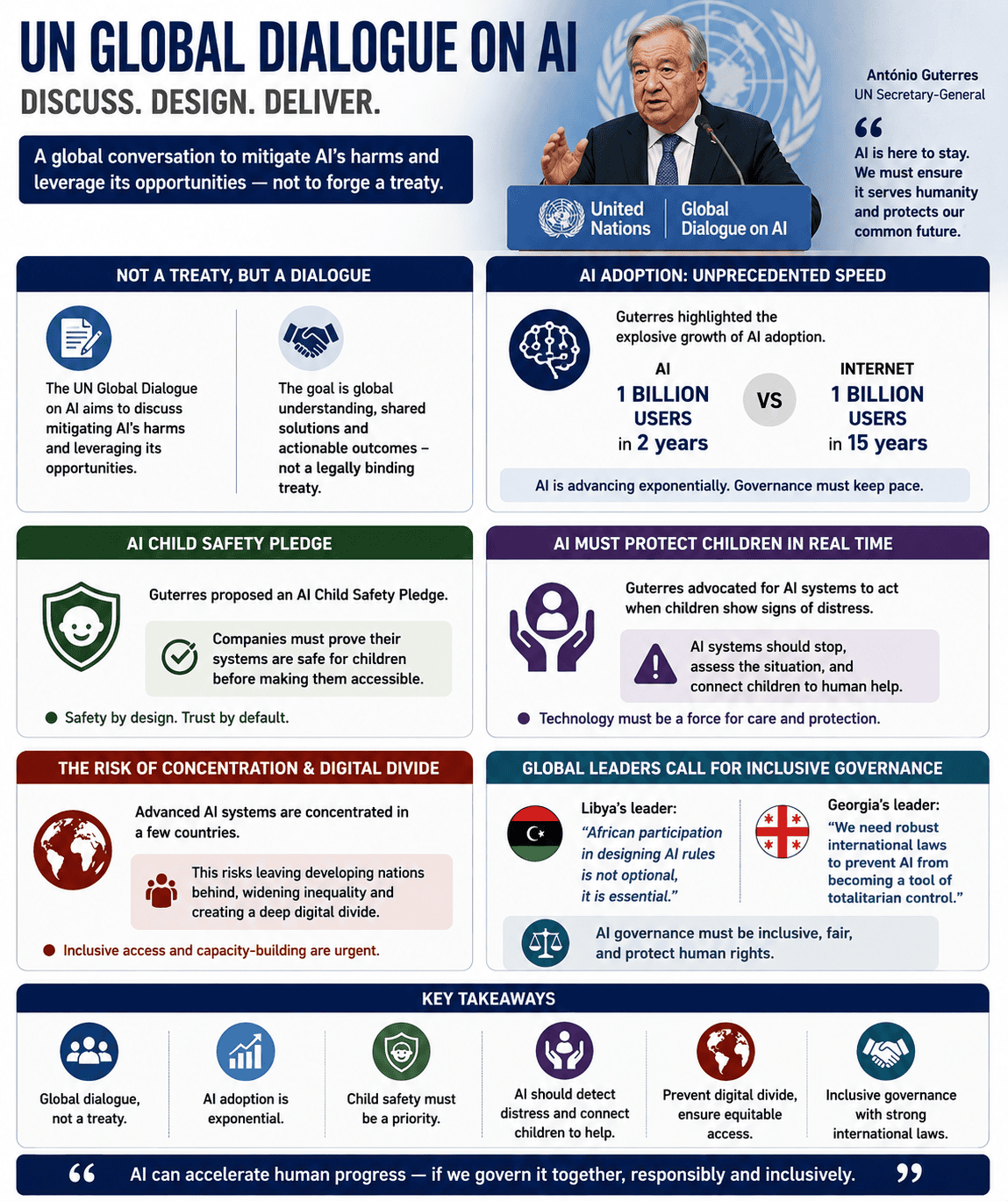
- The UN Global Dialogue on AI aims to discuss mitigating AI's harms and leveraging its opportunities, rather than forging a treaty.
- Guterres highlighted that AI reached a billion users in two years, compared to 15 years for the internet, underscoring its rapid adoption.
- He proposed an AI Child Safety Pledge, requiring companies to prove system safety before making them accessible to children.
- Guterres also advocated for AI systems to stop and connect children to human help if signs of distress are detected.
- The concentration of advanced AI systems in a few countries risks leaving developing nations behind, creating a significant digital divide.
- Leaders from Libya and Georgia emphasized the need for African participation in AI rule design and robust international laws to prevent totalitarian control.
Key Concepts Involved:
- AI Governance: The framework of policies, regulations, and ethical guidelines for the development and deployment of Artificial Intelligence.
- Digital Divide: The gap in access to or use of information and communication technologies, such as the internet and AI, between different populations.
- AI Child Safety Pledge: A proposed commitment by AI developers to ensure their systems are proven safe for children before public release.
Previous15/15

SuperKalam is your personal mentor for UPSC preparation, guiding you at every step of the exam journey.
Download the App


STUDY RESOURCES
CONTACT US
ⓒ Snapstack Technologies Private Limited