Pay Wall, Pg8
Government's move to allow charges on UPI transactions raises policy questions about funding digital infrastructure and potential impact on users.
Practice MCQs
833 Students attempted
Key Highlights:
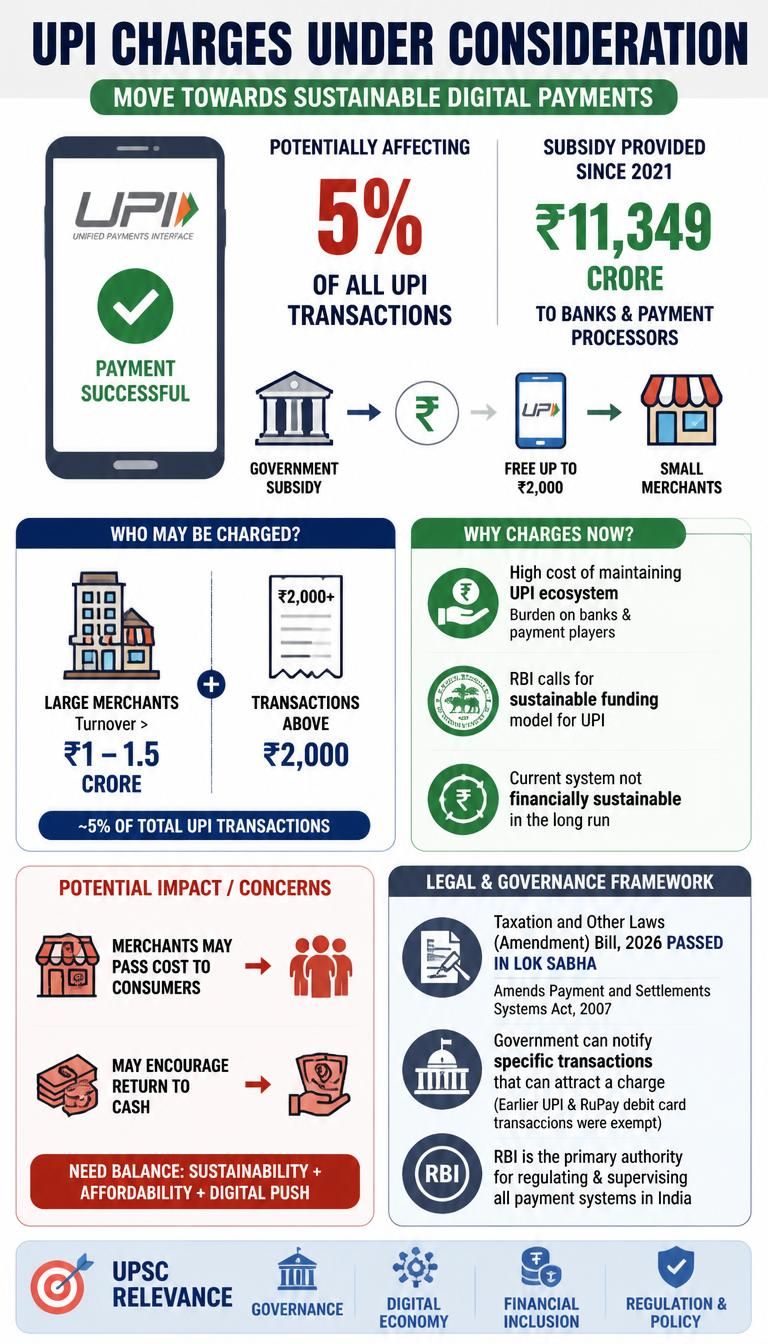
- The Indian government is considering allowing banks and payment processors to levy charges on Unified Payments Interface (UPI) transactions.
- The Lok Sabha recently passed the Taxation and Other Laws (Amendment) Bill, 2026, which amended the Payment and Settlements Systems Act, 2007.
- This amendment grants the government the power to notify specific types of transactions that can attract a charge, a departure from the previous exemption for UPI and RuPay debit card transactions.
- Initial proposals suggest charges might apply to large merchants with turnovers exceeding ₹1 crore-₹1.5 crore and for transactions above ₹2,000, potentially impacting around 5% of all UPI transactions.
- Since 2021, the government has provided subsidies totaling approximately ₹11,349 crore to banks and payment processors to cover the costs of UPI transactions up to ₹2,000 for small merchants.
UPI.jpg
Detailed Insights:
- The potential introduction of charges aims to address the financial burden on payment ecosystem players who have been maintaining UPI since it became free in 2020.
- Reserve Bank of India (RBI) Governor Sanjay Malhotra highlighted the necessity for a sustainable funding model for UPI.
- Concerns have been raised that imposing charges could lead to merchants passing costs to consumers, potentially encouraging a return to cash transactions.
- The Taxation and Other Laws (Amendment) Bill, 2026, also seeks to enhance India's investment climate and promote ease of doing business.
- The Payment and Settlements Systems Act, 2007, designates the RBI as the primary authority for regulating and supervising all payment systems in India.
- An alternative funding suggestion involves the RBI contributing to UPI's development by utilizing a portion of its annual surplus transferred to the Central government.
- The Payments Council of India (PCI) has clarified that UPI will remain free for consumers and small merchants, with any merchant service charges being commercial agreements for large merchants.
Key Concepts Involved:
- Unified Payments Interface (UPI): A real-time payment system developed by the National Payments Corporation of India (NPCI) for instant inter-bank fund transfers via mobile platforms.
- RuPay: An Indian multinational financial services and payment network, conceived and launched by the National Payments Corporation of India (NPCI).
- Payment and Settlements Systems Act, 2007: An Act that provides for the regulation and supervision of payment systems in India, designating the Reserve Bank of India (RBI) as the authority.
- Demonetisation: The act of stripping a currency unit of its status as legal tender, notably implemented in India in 2016 to curb black money and promote digital transactions.
- Merchant Discount Rate (MDR): A fee charged to merchants by banks for processing digital transactions, which was removed for UPI transactions in 2020.

SuperKalam is your personal mentor for UPSC preparation, guiding you at every step of the exam journey.
Download the App


STUDY RESOURCES
CONTACT US
ⓒ Snapstack Technologies Private Limited