Prudent Approach, Pg8
RBI maintains repo rate at 5.25% for fourth time, adopting a prudent 'wait-and-watch' approach amidst global uncertainties and rising inflation.
Practice MCQs
833 Students attempted
Key Highlights:
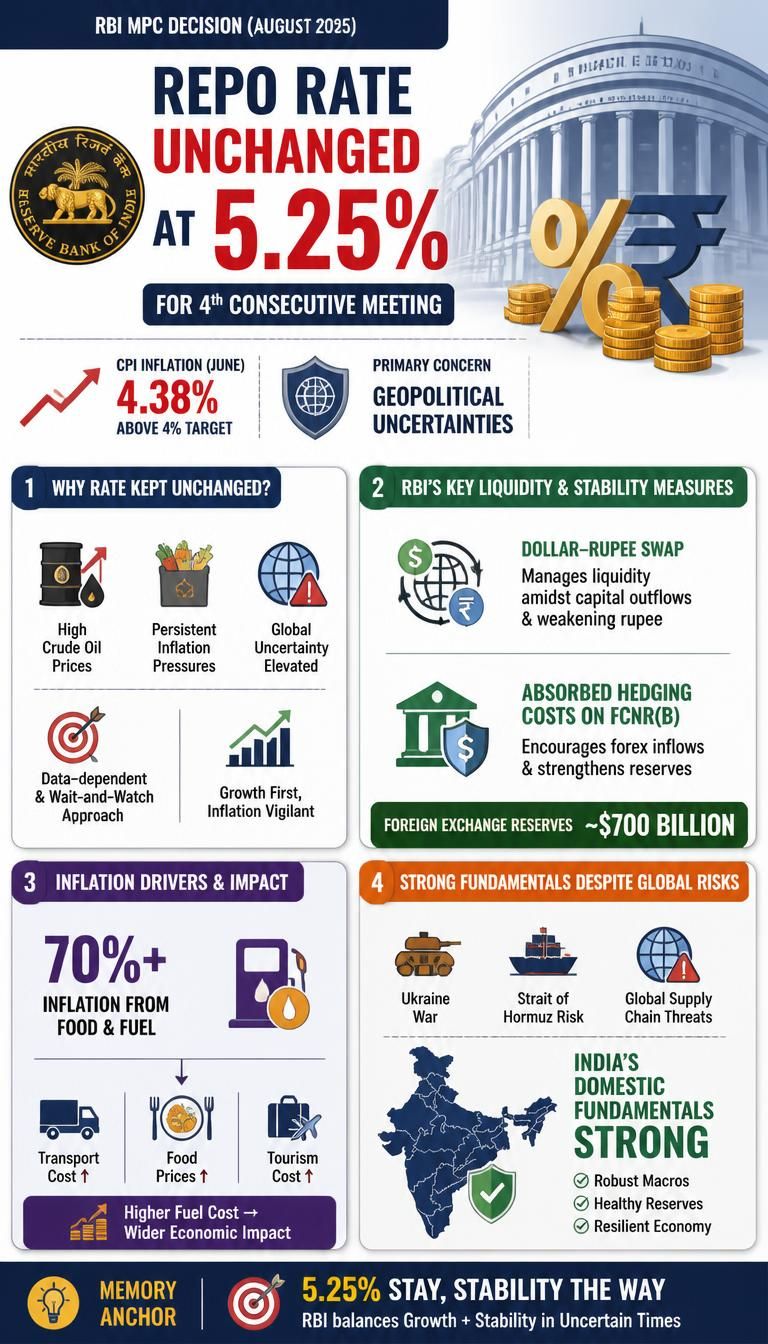
- The Reserve Bank of India (RBI)'s Monetary Policy Committee (MPC) kept the repo rate unchanged at 5.25% for the fourth consecutive meeting in early August.
- Retail inflation, measured by CPI, rose to 4.38% in June, exceeding the central bank's 4% target.
- RBI Governor Sanjay Malhotra indicated the central bank's primary concern is containing the fallout of mounting geopolitical uncertainties.
- The RBI implemented measures like a dollar-rupee swap and absorbed hedging costs on Foreign Currency Non-Resident (Bank) deposits (FCNR(B)).
- These actions aim to maintain domestic liquidity, shore up foreign exchange reserves (close to $700 billion), and manage the weakening rupee.
Repo rate.jpg
Detailed Insights:
- The decision to maintain the repo rate was largely anticipated due to elevated global crude prices and persistent inflationary pressures.
- The dollar-rupee swap helps manage liquidity in the domestic market amidst capital outflows and a depreciating rupee.
- Absorbing hedging costs on FCNR(B) deposits encourages foreign currency inflows, bolstering India's foreign exchange reserves.
- While inflation is largely attributed to food and fuel, higher fuel costs have broader implications for sectors like transport, food, and tourism.
- Despite global supply chain threats from the Ukraine war and potential issues in the Strait of Hormuz, India's domestic fundamentals remain strong.
- The RBI is prioritizing growth while remaining vigilant about inflationary pressures, adopting a "data-dependent" and "wait-and-watch" approach.
Key Concepts Involved:
- Reserve Bank of India (RBI): India's central bank, responsible for monetary policy, financial stability, and currency issuance.
- Monetary Policy Committee (MPC): A six-member committee that determines the benchmark interest rate (repo rate) to achieve the inflation target.
- Repo Rate: The interest rate at which the RBI lends money to commercial banks, influencing liquidity and credit in the economy.
- Retail Inflation (CPI): A measure of the average change over time in the prices paid by urban consumers for a basket of consumer goods and services.
- Foreign Currency Non-Resident (Bank) deposits (FCNR(B)): Term deposits held by Non-Resident Indians (NRIs) in foreign currency with Indian banks.
- Foreign Exchange Reserves: Assets held by a central bank in foreign currencies, used to back liabilities and manage the exchange rate.
- Strait of Hormuz: A narrow, strategically vital waterway connecting the Persian Gulf to the Gulf of Oman, crucial for global oil shipments.

SuperKalam is your personal mentor for UPSC preparation, guiding you at every step of the exam journey.
Download the App


STUDY RESOURCES
CONTACT US
ⓒ Snapstack Technologies Private Limited