Saudi, Turkey, Pak Sign Key Defence Pact, Pg1
Saudi Arabia, Turkey, and Pakistan sign a landmark joint defence agreement in Mecca to counter regional aggression and bolster collective security amidst escalating Middle East tensions.
Practice MCQs
833 Students attempted
Key Highlights:
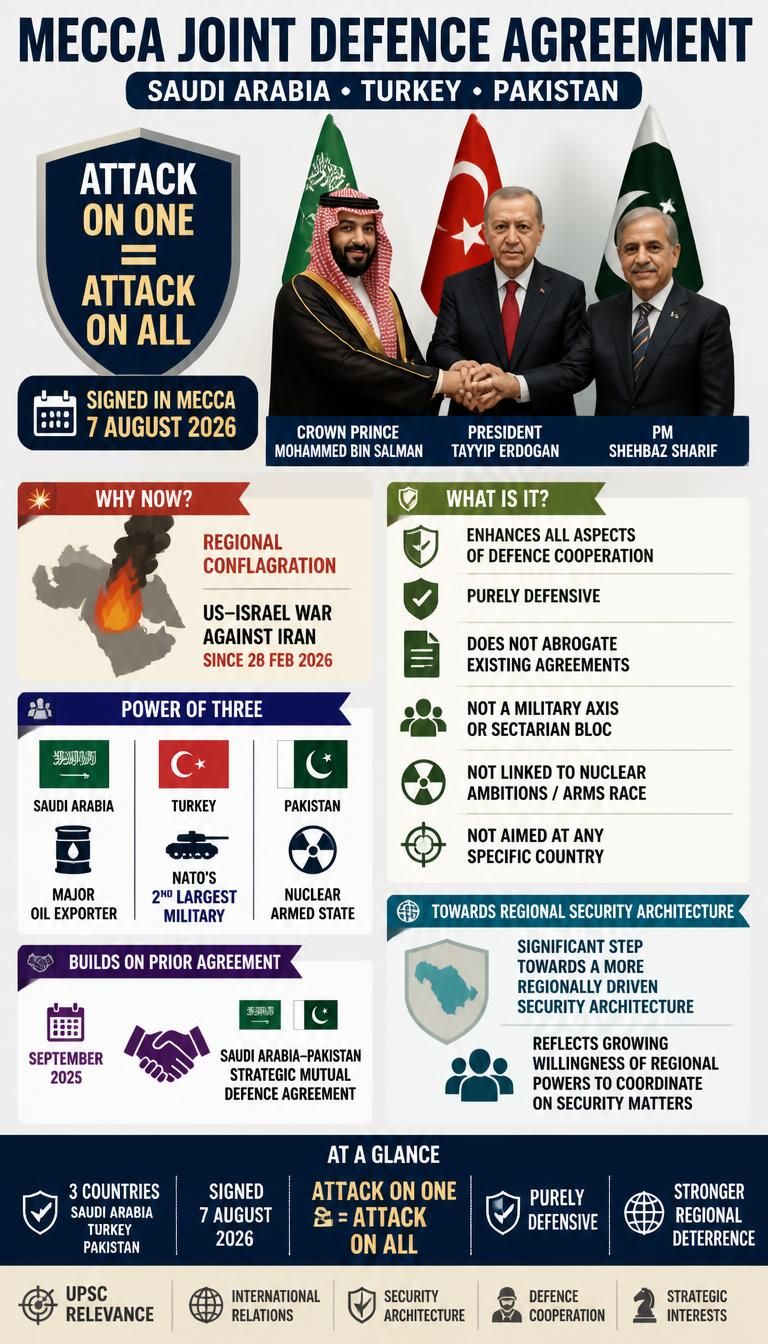
- Saudi Arabia, Turkey, and Pakistan signed the Mecca Joint Defence Agreement in Mecca on August 7, 2026.
- The pact stipulates that an armed attack against any of the three nations would be regarded as an attack on all, aiming to strengthen collective deterrence.
- The agreement was signed by Saudi Crown Prince Mohammed bin Salman, Turkish President Tayyip Erdogan, and Pakistan Prime Minister Shehbaz Sharif.
- This development occurred amidst a regional conflagration, including an ongoing war involving the US and Israel against Iran, which began on February 28, 2026.
Defence Pact.jpg
Detailed Insights:
- The Mecca Joint Defence Agreement is intended to enhance all aspects of defense cooperation among the three states.
- Officials stated the agreement is purely defensive, not aimed at any specific country, and does not abrogate existing international agreements.
- The pact is not intended to establish a military axis or a sectarian bloc, nor is it linked to any nuclear ambitions or arms race.
- The three signatory nations are influential Muslim states: Turkey possesses NATO's second-largest military, Saudi Arabia is a major oil exporter, and Pakistan is a nuclear-armed country.
- The agreement follows nearly a year of negotiations and builds upon a bilateral Strategic Mutual Defence Agreement signed between Saudi Arabia and Pakistan in September 2025.
- The pact is seen as a significant step towards a more regionally driven security architecture, reflecting a growing willingness among regional powers to coordinate on security matters.
Key Concepts Involved:
- Mecca Joint Defence Agreement: A trilateral collective-defense pact signed by Saudi Arabia, Pakistan, and Turkey, committing to mutual defense.
- Collective Deterrence: A strategy where the threat of retaliation by multiple states discourages an attack on any one member.
- Regional Security Architecture: A framework of agreements and institutions designed to manage security challenges within a specific geographic region.
- NATO Article 5: The principle that an armed attack against one or more members of the North Atlantic Treaty Organization is considered an attack against all.

SuperKalam is your personal mentor for UPSC preparation, guiding you at every step of the exam journey.
Download the App


STUDY RESOURCES
CONTACT US
ⓒ Snapstack Technologies Private Limited