'UPI's growth needs money, small payments won't face MDR', Pg17
Government explores Merchant Discount Rate on large UPI transactions to fund growth, exempting small payments, following legislative changes to the Payment Systems Act.
Practice MCQs
833 Students attempted
Key Highlights:
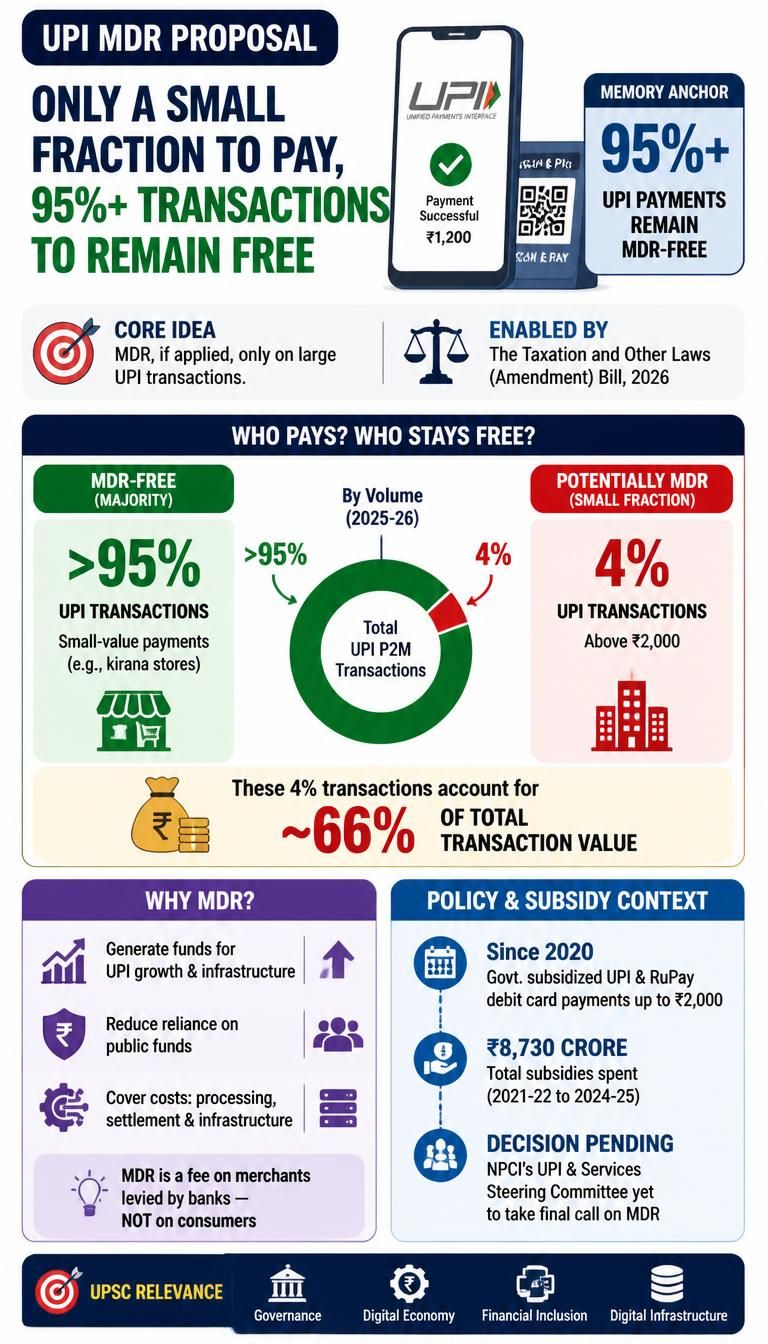
- A potential Merchant Discount Rate (MDR) on UPI transactions may apply only to a small fraction of payments, primarily large transactions.
- Over 95% of UPI transactions, especially small-value payments at places like kirana stores, are expected to remain free of MDR.
- The government introduced The Taxation and Other Laws (Amendment) Bill, 2026, which allows for charging fees on UPI and RuPay debit card payments.
- The National Payments Corporation of India (NPCI)'s UPI and Services Steering Committee is yet to make a final decision on the MDR.
UPI MDR.jpg
Detailed Insights:
- The proposed MDR aims to generate funds for UPI's growth and infrastructure development, reducing reliance on public funds.
- In 2025-26, only 4% of person-to-merchant (P2M) UPI payments exceeded Rs 2,000, but these accounted for two-thirds of the total transaction value.
- MDR is a fee levied on merchants by banks to cover transaction processing, settlement, and infrastructure costs, not directly on consumers.
- Since 2020, the government has subsidized UPI and RuPay debit card payments up to Rs 2,000, with subsidies totaling Rs 8,730 crore from 2021-22 to 2024-25.
- The Payments Council of India (PCI) clarified that small merchants are not charged for accepting UPI payments and consumers do not pay a fee.
- UPI transactions have seen massive growth, with over 24,000 crore transactions worth Rs 314 lakh crore in 2025-26, leading to significant operational costs for the industry.
Key Concepts Involved:
- Unified Payments Interface (UPI): An instant real-time payment system developed by NPCI facilitating inter-bank peer-to-peer and person-to-merchant transactions.
- Merchant Discount Rate (MDR): A fee charged to a merchant by a bank for processing debit or credit card transactions.
- Payment and Settlement Systems Act, 2007: An Indian law that provides for the regulation and supervision of payment systems in India.
- National Payments Corporation of India (NPCI): An umbrella organization for operating retail payments and settlement systems in India, promoted by the Reserve Bank of India.

SuperKalam is your personal mentor for UPSC preparation, guiding you at every step of the exam journey.
Download the App


STUDY RESOURCES
CONTACT US
ⓒ Snapstack Technologies Private Limited