As U.S. Senate Clears Bill, 100% Tariff Threat Looms, Pg1
U.S. Senate clears Bill threatening 100% tariffs on India for Russian oil imports, potentially impacting bilateral trade relations significantly.
Practice MCQs
840 Students attempted
Key Highlights:
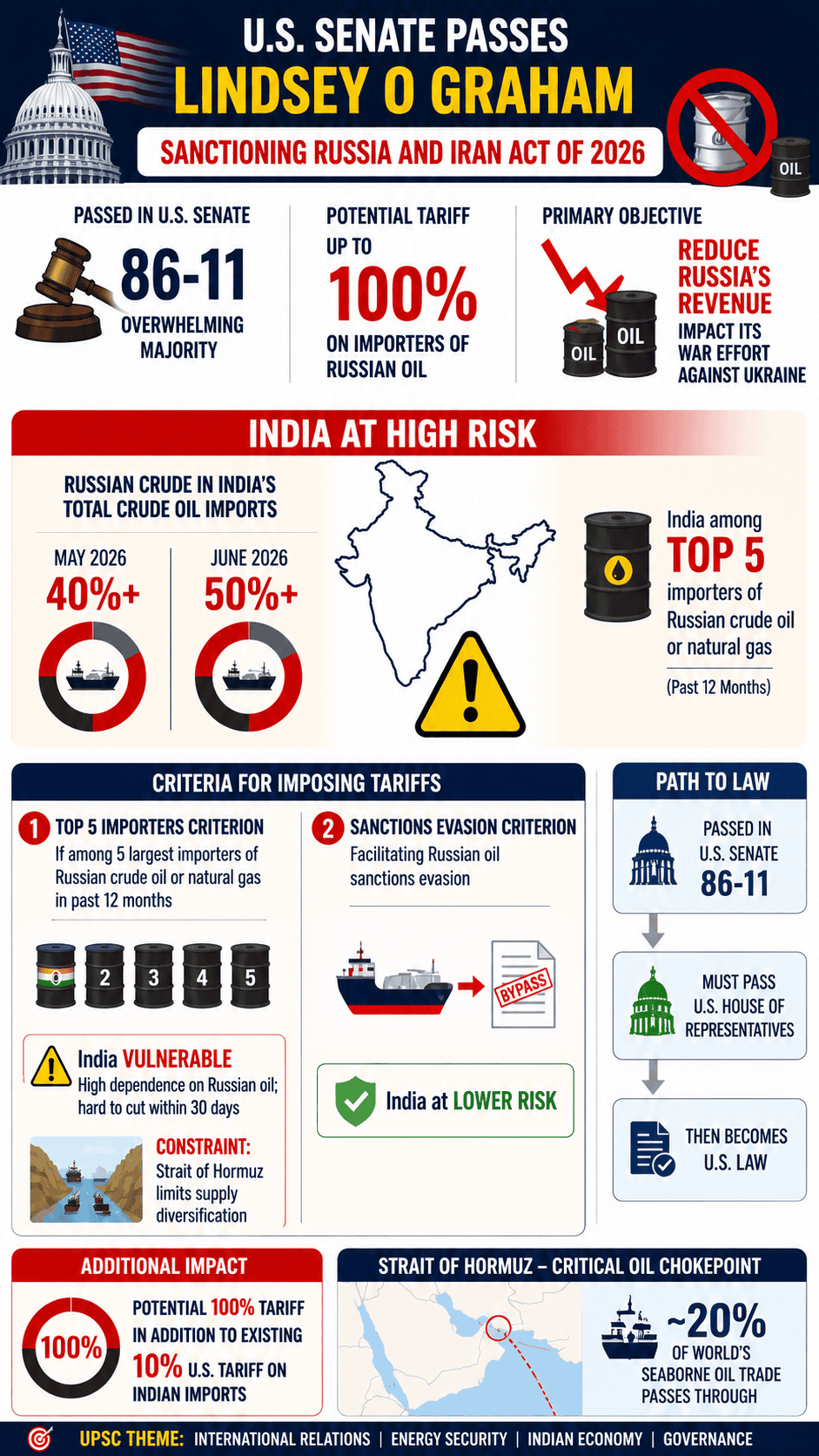
- The U.S. Senate has passed the Lindsey O Graham Sanctioning Russia and Iran Act of 2026 with an overwhelming majority of 86-11 votes.
- This Bill could lead to the imposition of up to 100% tariffs on countries importing Russian oil.
- The primary objective of the Act is to reduce Russia's revenue, thereby impacting its war efforts against Ukraine.
- India faces a significant risk of these tariffs as it is among the top importers of Russian crude oil.
- Russian crude accounted for over 40% of India's total crude oil imports in May 2026 and more than 50% in June 2026.
US Senate_.png
Detailed Insights:
- The Lindsey O Graham Sanctioning Russia and Iran Act of 2026 must pass the House of Representatives before becoming law.
- The Bill stipulates that tariffs would apply to countries among the five largest importers of Russian crude oil or natural gas in the 12 months preceding the Act's enactment.
- India's substantial reliance on Russian oil makes it vulnerable under this criterion.
- Rapidly scaling back Russian oil imports within 30 days would be challenging for India, especially given constraints in the Strait of Hormuz.
- The Strait of Hormuz is a critical maritime chokepoint through which a significant portion of the world's seaborne oil trade passes.
- A second criterion for tariffs involves facilitating Russian oil sanctions evasion, under which India faces a lower risk.
- These potential 100% tariffs would be in addition to the existing 10% tariff the U.S. currently imposes on imports from India.
Key Concepts Involved:
- Tariffs: Taxes imposed by a government on imported goods and services.
- Sanctions: Financial and trade penalties imposed by one country on another to compel a change in policy or behavior.
- Strait of Hormuz: A narrow, strategically vital waterway connecting the Persian Gulf with the Gulf of Oman and the Arabian Sea, crucial for global oil transit.
- Lindsey O Graham Sanctioning Russia and Iran Act of 2026: A proposed U.S. law aimed at imposing sanctions on Russia's energy sector and financial institutions, and authorizing tariffs on its major oil and gas purchasers.

SuperKalam is your personal mentor for UPSC preparation, guiding you at every step of the exam journey.
Download the App


STUDY RESOURCES
CONTACT US
ⓒ Snapstack Technologies Private Limited