Trilateral defence pact is similar to NATO’s Article 5, Turkish Minister, Pg16
Turkiye, Pakistan, and Saudi Arabia form a trilateral defense pact, with its collective security clause mirroring NATO's Article 5, establishing a new secretariat.
Practice MCQs
840 Students attempted
Key Highlights:
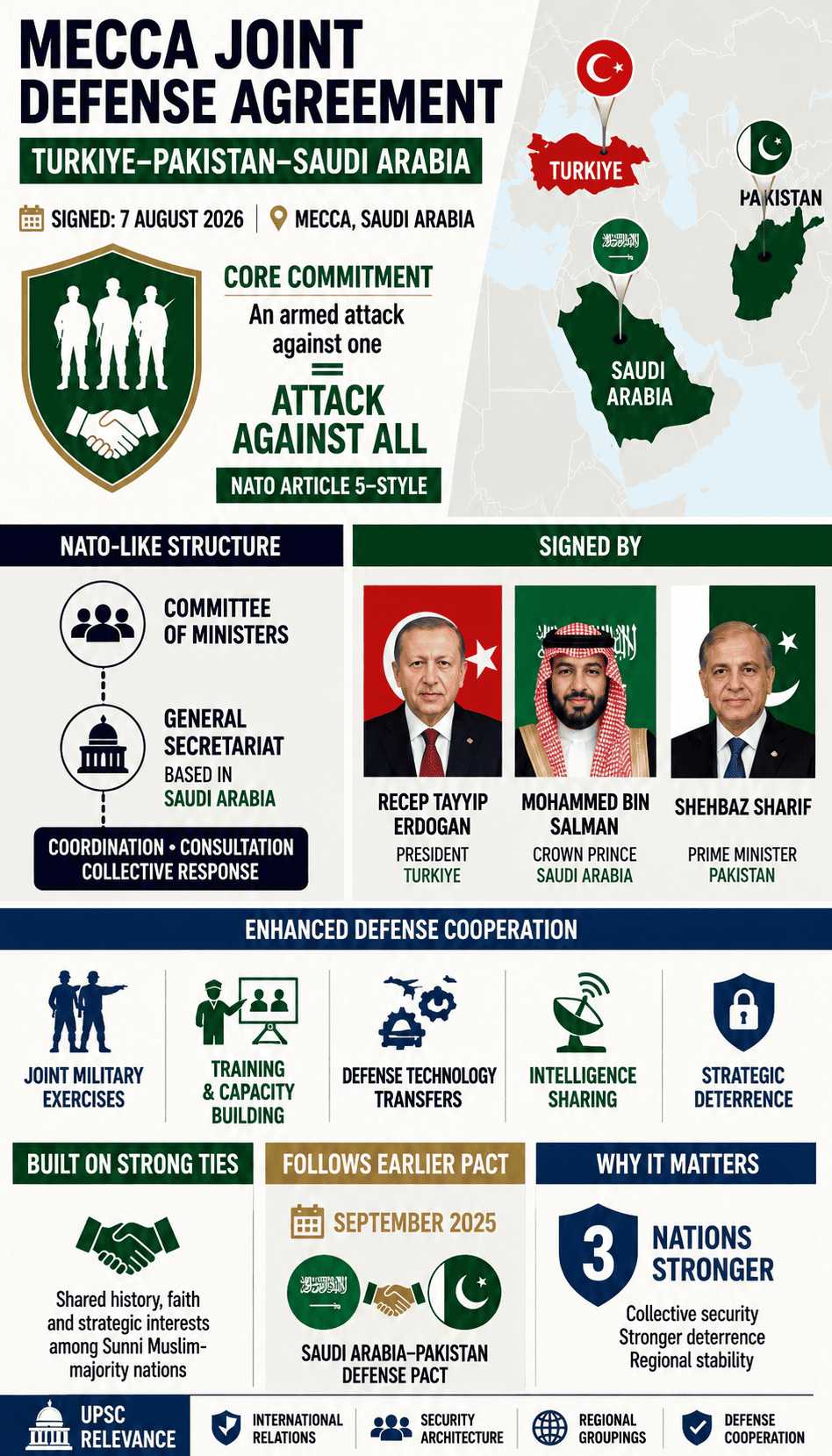
- Turkiye, Pakistan, and Saudi Arabia signed a trilateral defense pact, the Mecca Joint Defense Agreement, on August 7, 2026, in Mecca, Saudi Arabia.
- Turkish Foreign Minister Hakan Fidan stated the pact is "technically the same" as NATO's Article 5 mutual defense agreement.
- The agreement stipulates that an armed attack against any one of the three nations will be considered an attack against all.
- The pact will establish a committee of ministers and a General Secretariat based in Saudi Arabia, similar to NATO's structure.
- The agreement was signed by Turkish President Recep Tayyip Erdogan, Saudi Crown Prince Mohammed bin Salman, and Pakistani Prime Minister Shehbaz Sharif.
Mecca_.png
Detailed Insights:
- The Mecca Joint Defense Agreement aims to strengthen collective deterrence against aggression and enhance defense cooperation among the three nations.
- This cooperation is expected to include joint military exercises, training, technology transfers, and intelligence sharing.
- The pact reflects the longstanding historical ties and shared strategic interests among these three Sunni Muslim-majority countries.
- It follows a previous bilateral defense pact signed between Saudi Arabia and Pakistan in September 2025.
- The agreement is described as purely defensive and not targeting any specific country, with Turkish officials stating it does not conflict with existing alliances like NATO.
- Egypt has been identified as a potential candidate to join the alliance once technical matters are resolved.
- The formation of this new regional security framework could potentially reshape the balance of power amid ongoing regional tensions.
Key Concepts Involved:
- NATO's Article 5: A collective defense principle stating that an armed attack against one member is considered an attack against all members.
- Collective Deterrence: A strategy aimed at preventing aggression by ensuring a unified and strong response from an alliance.
- General Secretariat: An administrative body responsible for coordinating the activities and implementing the mechanisms of an international organization or pact.

SuperKalam is your personal mentor for UPSC preparation, guiding you at every step of the exam journey.
Download the App


STUDY RESOURCES
CONTACT US
ⓒ Snapstack Technologies Private Limited