US reviews plan to end 60-day grace period for foreign workers to find new jobs, Pg12
US Department of Homeland Security considers ending 60-day grace period for H-1B and other visa holders, mandating immediate exit post-job loss.
Practice MCQs
840 Students attempted
Key Highlights:
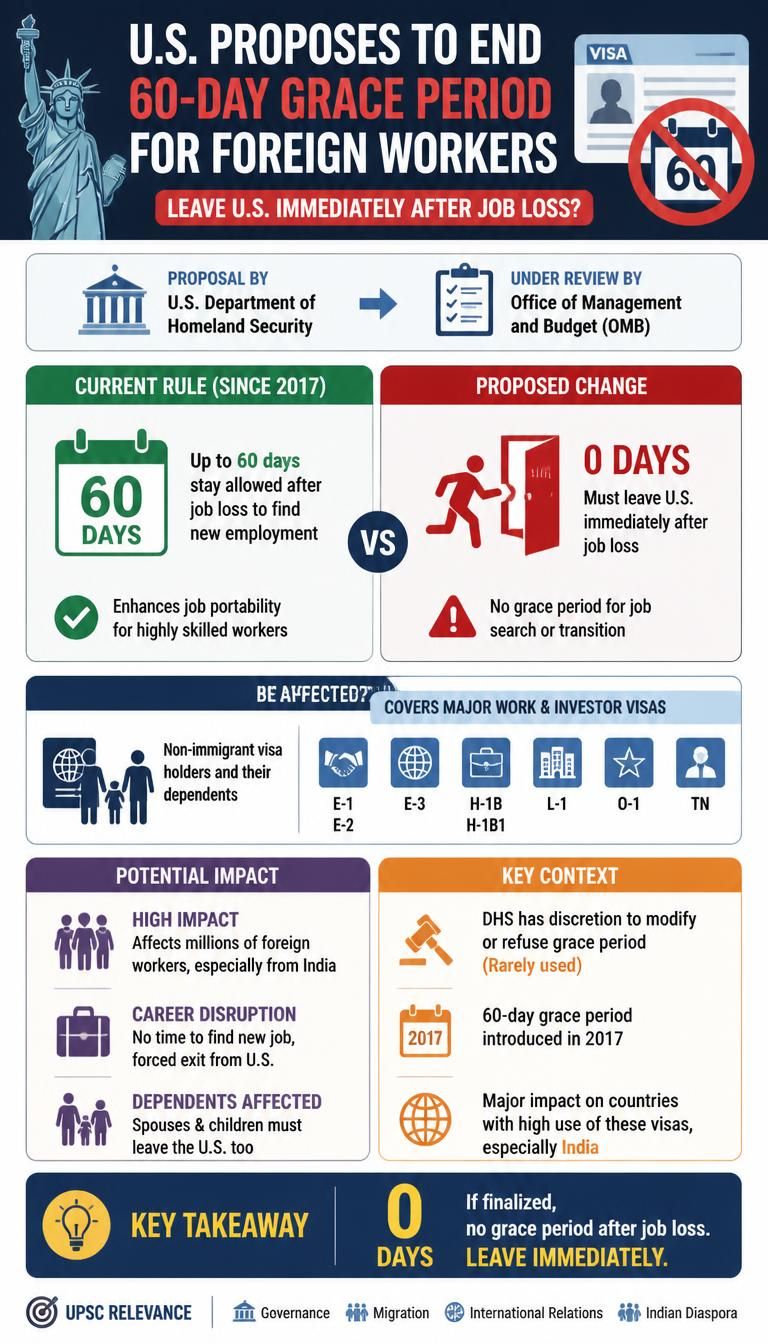
- The U.S. is reviewing a proposal to eliminate the 60-day grace period for foreign workers on non-immigrant visas who lose their jobs.
- This proposal, from the Department of Homeland Security, is currently under review by the Office of Management and Budget.
- If finalized, the change would require certain non-immigrant visa holders and their dependents to leave the country immediately after job loss.
- The 60-day grace period was initially introduced in 2017 to provide a window for foreign workers to find new employment.
US 60 day.jpg
Detailed Insights:
- The existing 60-day grace period allows non-immigrant workers to remain in the U.S. for up to two months after employment cessation to seek new jobs.
- This provision was established in 2017 to enhance job portability for highly skilled non-immigrants.
- The proposed elimination would affect holders of E-1, E-2, E-3, H-1B, H-1B1, L-1, O-1, and TN non-immigrant visas and their dependents.
- Immigration consultants note that the Department of Homeland Security has the discretion to modify or refuse the grace period, though it has rarely done so.
- The potential change could significantly impact foreign workers, particularly those from countries like India, who heavily utilize these visa categories.
- The review by the Office of Management and Budget indicates the proposal is moving through the federal regulatory process.
Key Concepts Involved:
- Department of Homeland Security (DHS): A U.S. federal executive department responsible for public security, including immigration enforcement and border control.
- Office of Management and Budget (OMB): The largest office within the Executive Office of the President, responsible for overseeing the federal budget and reviewing federal regulations.
- Non-immigrant visas: Temporary visas for foreign nationals to enter the U.S. for specific purposes like work, study, or tourism, without intending permanent residency.
- E-1 Visa: For treaty traders engaged in substantial trade between the U.S. and a treaty country.
- E-2 Visa: For treaty investors making a substantial investment in a U.S. business.
- E-3 Visa: For Australian citizens working in specialty occupations.
- H-1B Visa: For foreign workers in specialty occupations requiring a bachelor's degree or higher.
- H-1B1 Visa: A treaty-based work visa for professionals from Chile and Singapore in specialty occupations.
- L-1 Visa: For intra-company transferees (managers, executives, or specialized knowledge employees) from foreign offices to U.S. offices.
- O-1 Visa: For individuals with extraordinary ability or achievement in sciences, arts, education, business, or athletics.
- TN Visa: For Canadian and Mexican citizens to work in specific professional occupations under the United States-Mexico-Canada Agreement (USMCA).

SuperKalam is your personal mentor for UPSC preparation, guiding you at every step of the exam journey.
Download the App


STUDY RESOURCES
CONTACT US
ⓒ Snapstack Technologies Private Limited