Area of safe haven carved out for lions in Gujarat, Pg8
Gujarat forest department establishes 100-hectare enclosure at Ambardi Safari Park to house Asiatic lions involved in human attacks, mitigating conflict.
Practice MCQs
847 Students attempted
Key Highlights:
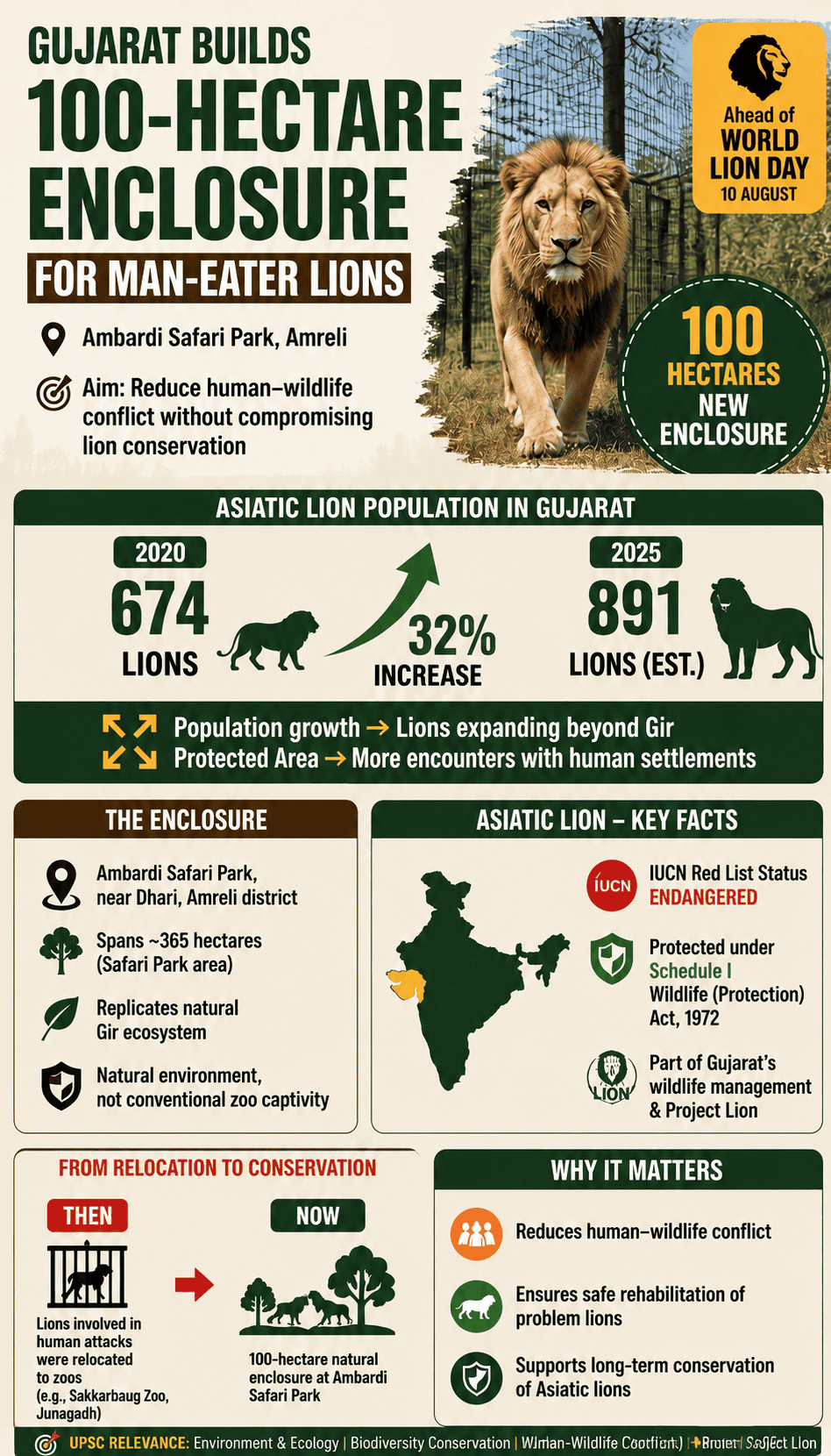
- The Gujarat forest department is establishing a 100-hectare enclosure at the Ambardi Safari Park in Amreli district.
- This facility is designed to house Asiatic lions that have attacked humans, aiming to mitigate human-wildlife conflicts.
- The initiative is part of Gujarat's broader wildlife management strategy and was announced ahead of World Lion Day.
- The enclosure will provide a natural environment for these lions, differing from conventional zoo captivity.
Lion_.png
Detailed Insights:
- The Asiatic lion population in Gujarat has significantly increased, reaching an estimated 891 individuals in 2025, up from 674 in 2020.
- This population growth has led to lions expanding their range beyond the Gir Protected Area, increasing encounters with human settlements.
- The Ambardi Safari Park, located near Dhari in Amreli district, spans approximately 365 hectares and replicates the Gir ecosystem.
- The Asiatic lion is classified as 'Endangered' by the IUCN Red List and is protected under Schedule I of the Wildlife (Protection) Act, 1972.
- This measure is intended to reduce conflict without compromising long-term lion conservation, complementing efforts like Project Lion.
- Previously, lions involved in human attacks were often relocated to zoos like Sakkarbaug Zoo in Junagadh.
Key Concepts Involved:
- Human-Wildlife Conflict: Interactions between wild animals and humans that result in negative impacts on human social, economic, or cultural life, on the conservation of wildlife populations, or on the environment.
- Ex-situ Conservation: Conservation of components of biological diversity outside their natural habitats, such as in zoos, botanical gardens, or specialized enclosures.
- IUCN Red List: The world's most comprehensive inventory of the global conservation status of biological species, categorizing species based on their extinction risk.

SuperKalam is your personal mentor for UPSC preparation, guiding you at every step of the exam journey.
Download the App


STUDY RESOURCES
CONTACT US
ⓒ Snapstack Technologies Private Limited