If DNA Is The Instruction Manual, We Just Opened A Big Second Volume, Pg2
New research reveals non-Mendelian epigenetic inheritance in mice, challenging genetic rules and offering profound insights into complex human health conditions.
Practice MCQs
847 Students attempted
Key Highlights:
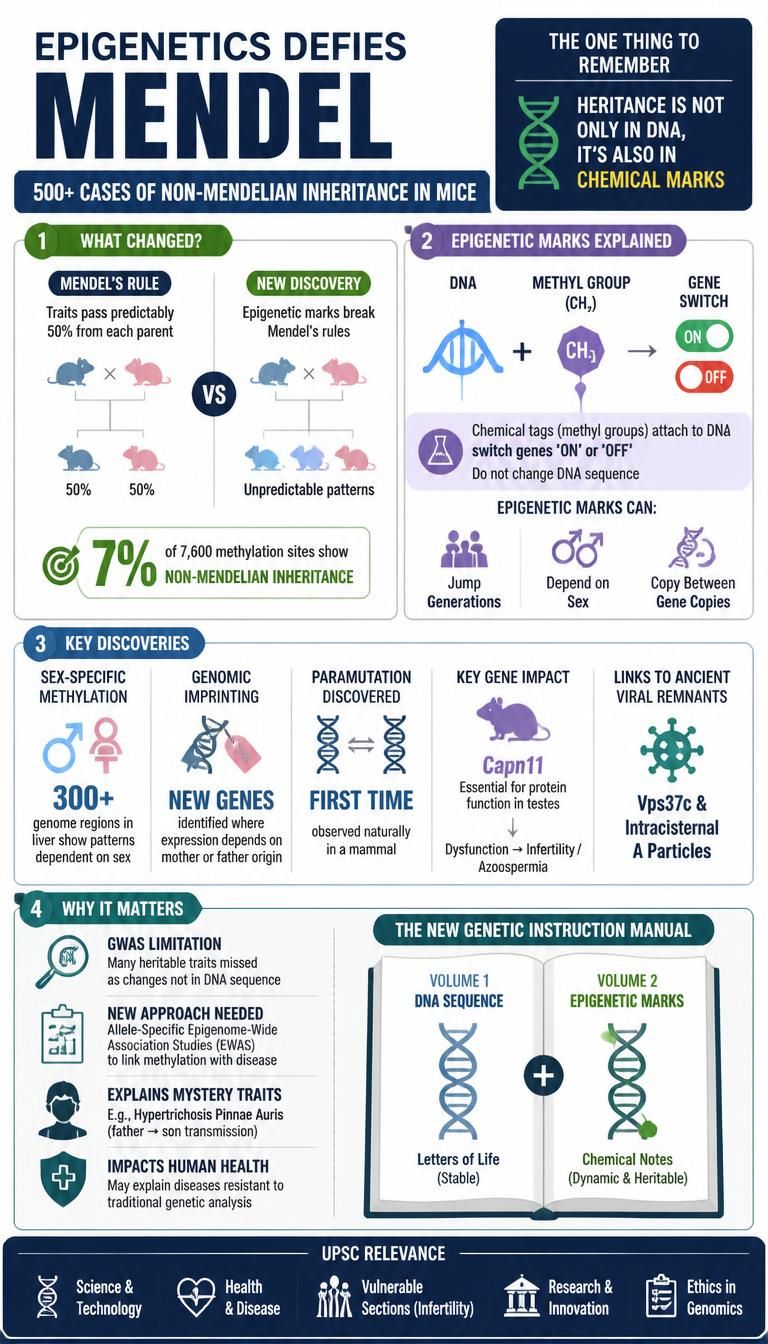
- Researchers at Johns Hopkins School of Medicine discovered that inherited traits in mice can defy Gregor Mendel's rules due to epigenetic modifications.
- These chemical modifications, involving methyl groups, can jump generations, depend on an animal's sex, and even copy themselves between gene copies.
- The study, published in Nature Genetics, identified over 500 instances of non-Mendelian epigenetic inheritance, including sex-specific methylation and paramutation.
- This discovery suggests a "second volume" to the genetic instruction manual, potentially explaining human health conditions resistant to traditional genetic analysis.
Epigenetics.jpg
Detailed Insights:
- Cells contain DNA sequence information and epigenetic modifications, which involve attaching methyl groups to DNA to switch genes 'on' or 'off'.
- These modifications do not alter the underlying DNA sequence and can differ between tissues, though many are reversed during gamete formation.
- The study utilized nanopore sequencing to detect methylated cytosines by their distinct electrical blips as DNA passes through a pore.
- Approximately 7% of the 7,600 differing methylation locations showed non-Mendelian inheritance, challenging previous assumptions.
- Over 300 genome regions in the liver exhibited methylation patterns dependent on the mouse's sex, a scale previously underestimated.
- The research identified new genes displaying genomic imprinting, where gene expression depends on whether it was inherited from the mother or father.
- Paramutation, the transfer of methylation status from one gene copy to another, was observed naturally in a mammal for the first time.
- The paramutated gene Capn11 is crucial for protein activity in testes, and its dysfunction can lead to infertility or azoospermia.
- Instances of paramutation were also linked to Vps37c and intracisternal A particles, genetic remnants of ancient viruses.
- This new framework could explain heritable traits like hypertrichosis pinnae auris, which is transmitted from fathers to sons.
- The findings imply that Genome-Wide Association Studies (GWAS) may miss significant heritable variation not found in DNA sequences.
- The study proposes Allele-Specific Epigenome-Wide Association Studies to trace methylation patterns for disease association.
Scientific/Technical Concepts Involved:
- Epigenetic modification: Changes in gene expression without altering the DNA sequence, often involving chemical tags like methyl groups.
- Nanopore sequencing: A technology that reads DNA sequences and detects modifications by passing a single DNA strand through a tiny pore.
- Paramutation: An epigenetic phenomenon where one allele's expression state is heritably altered by interaction with another allele.
- Genome-Wide Association Studies (GWAS): Observational studies that scan entire genomes to find genetic variations associated with a disease or trait.
- Allele-Specific Epigenome-Wide Association Studies: A proposed method to identify disease-associated regions by tracing methylation patterns rather than DNA sequence variants.
- Genomic imprinting: An epigenetic phenomenon where certain genes are expressed in a parent-of-origin-specific manner.

SuperKalam is your personal mentor for UPSC preparation, guiding you at every step of the exam journey.
Download the App


STUDY RESOURCES
CONTACT US
ⓒ Snapstack Technologies Private Limited