Ladakh to lead Independent India’s first caste census, Pg1
Ladakh pioneers Independent India's first caste census from August 17, employing digital and paper schedules amidst border security considerations.
Practice MCQs
847 Students attempted
Key Highlights:
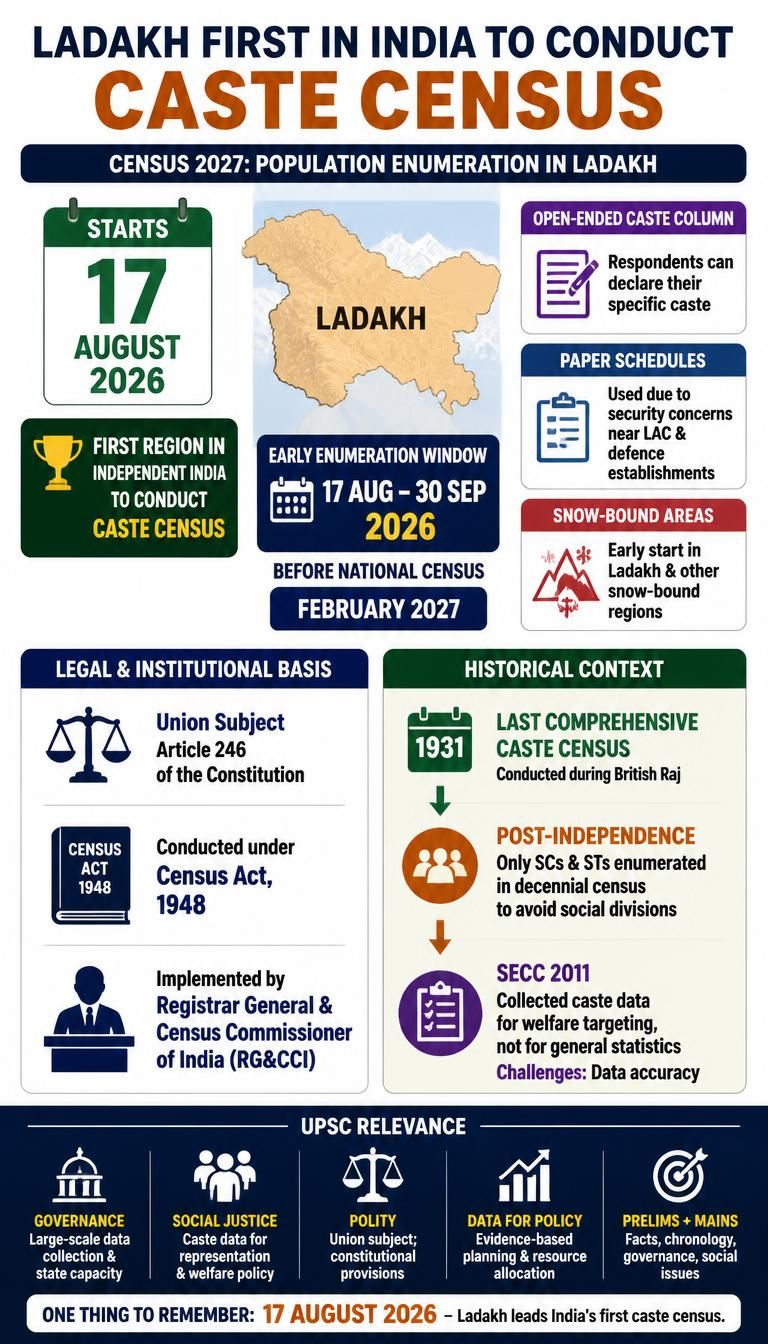
- Ladakh will initiate the Population Enumeration (PE) phase of the Census 2027 on August 17, 2026, making it the first region in Independent India to conduct a caste census.
- The census in Ladakh will feature an open-ended column for caste enumeration, allowing respondents to declare their specific caste.
- Due to security concerns regarding defence establishments along the Line of Actual Control (LAC), Ladakh's census will utilize traditional paper schedules, deviating from the nationwide digital census.
- The Registrar General and Census Commissioner of India (RG&CCI) has notified the early commencement of the census in Ladakh and other snow-bound areas, running until September 30, 2026.
- This early phase in Ladakh precedes the main national census exercise, which is scheduled for February 2027.
Ladakh.jpg
Detailed Insights:
- The Census of India is a Union subject under Article 246 of the Constitution and is conducted under the provisions of the Census Act, 1948.
- The last comprehensive caste census in India was conducted in 1931 during the British Raj; post-independence, only Scheduled Castes (SCs) and Scheduled Tribes (STs) were enumerated in the decennial census to avoid social divisions.
- The Socio-Economic Caste Census (SECC) 2011 collected caste data but was primarily aimed at identifying beneficiaries for welfare schemes, not for general population statistics, and faced challenges with data accuracy.
- The open-ended methodology for caste enumeration, where enumerators record the caste as declared by the respondent, was also used in the pre-test phase conducted in 16 states and Union Territories.
- Union Territories like Ladakh are administrative divisions directly governed by the central government through an appointed administrator.
- The Line of Actual Control (LAC) is the de facto boundary that separates Indian-controlled territory from Chinese-controlled territory in the context of the Sino-Indian border dispute.
Key Concepts Involved:
- Census of India: A decennial exercise mandated by the Constitution to collect demographic, social, and economic data of the entire population.
- Caste Census: The enumeration of caste-wise population data, last fully conducted in 1931.
- Population Enumeration (PE): The second phase of the census, focusing on collecting individual demographic and socio-economic details.
- Socio-Economic Caste Census (SECC): A survey conducted in 2011 to identify beneficiaries for government welfare programs based on socio-economic indicators and caste.
- Registrar General and Census Commissioner of India (RG&CCI): The statutory authority under the Ministry of Home Affairs responsible for planning and conducting the decennial census.
- Union Territory (UT): An administrative division in India that is directly governed by the central government.
- Line of Actual Control (LAC): The de facto border separating Indian and Chinese controlled territories.

SuperKalam is your personal mentor for UPSC preparation, guiding you at every step of the exam journey.
Download the App


STUDY RESOURCES
CONTACT US
ⓒ Snapstack Technologies Private Limited