Scientists can now shrink and rewrite proteins with AI. Here's what that unlocks, Pg11
Duke University scientists develop Raygun AI, an innovative system to miniaturize and rewrite proteins, promising breakthroughs in gene therapy and drug development.
Practice MCQs
847 Students attempted
Key Highlights:
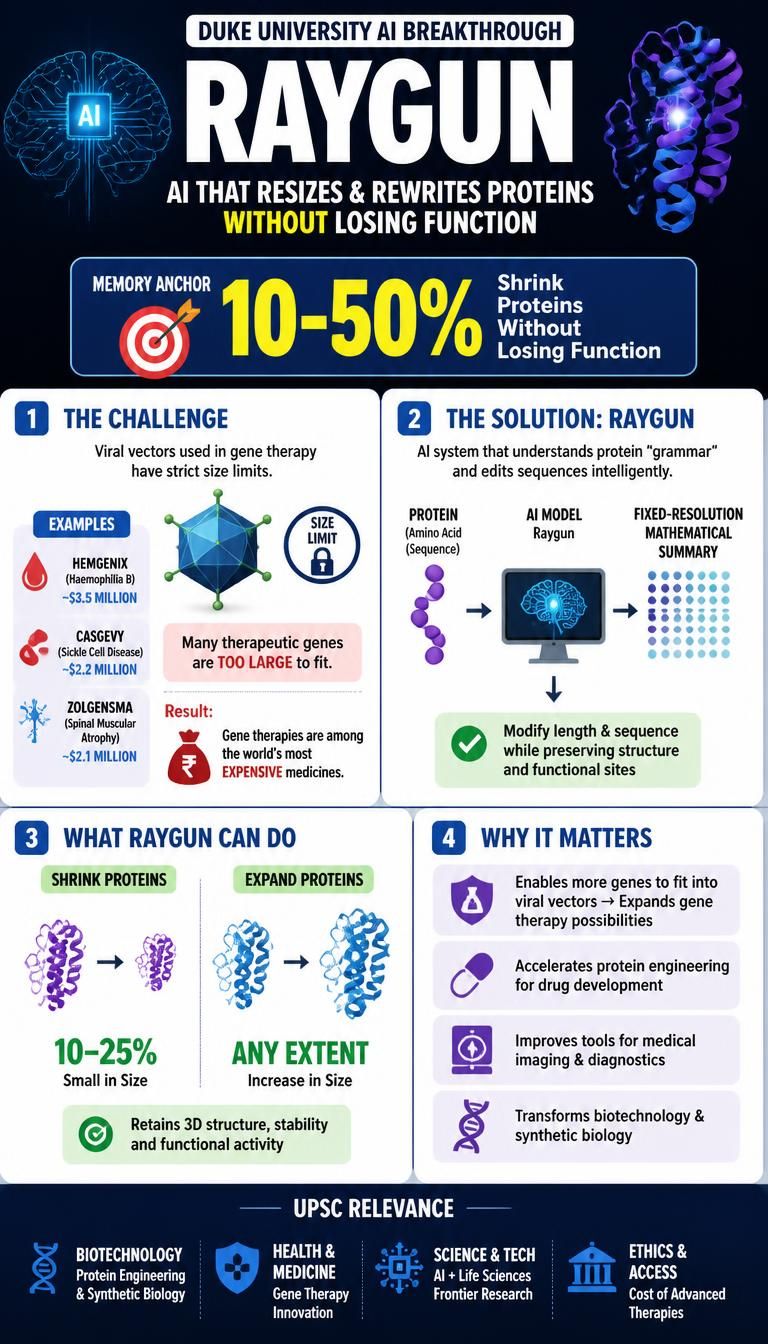
- Scientists at Duke University have developed an Artificial Intelligence system named Raygun that can miniaturize, enlarge, and extensively rewrite proteins while preserving their function.
- The research, published in the journal Nature, addresses a significant challenge in gene therapy where the size of therapeutic genes often exceeds the capacity of viral delivery vehicles.
- Raygun utilizes protein language models to understand the "grammar" of proteins, allowing it to modify their length and sequence based on a fixed-resolution summary.
- This technology holds potential for accelerating protein engineering in gene therapy, drug development, medical imaging, and biotechnology.
Raygun.jpg
Detailed Insights:
- Proteins are complex polymers made of amino acids, and their specific 3D shape dictates their function.
- Gene therapy aims to deliver functional genes into cells, but the viral vectors used have strict size limitations, making many therapeutic genes too large.
- Current gene therapies like Hemgenix for haemophilia, Casgevy for sickle cell disease, and Zolgensma for spinal muscular atrophy are among the most expensive medicines due to these constraints.
- Raygun overcomes this by converting proteins into a standardized mathematical format, enabling length modifications while retaining structural integrity and functional sites.
- The AI system can shrink proteins by 10-25%, sometimes over 50%, and also expand them, demonstrating significant flexibility in protein design.
- The model learns from evolutionary patterns, protecting what natural selection has optimized, but may not account for human-engineered additions.
- The development raises ethical considerations, with some scientists advocating for adherence to Responsible AI for Biodesign principles to prevent misuse.
Scientific/Technical Concepts Involved:
- Proteins: Large, complex molecules essential for virtually all biological processes, composed of amino acid chains.
- Gene Therapy: A medical approach that introduces, removes, or changes genetic material in a patient's cells to treat or prevent disease.
- Protein Language Models: AI systems trained on vast protein sequence data to learn patterns linking amino acid sequences to protein structure and function.
- Amino Acids: The fundamental building blocks that link together to form proteins.

SuperKalam is your personal mentor for UPSC preparation, guiding you at every step of the exam journey.
Download the App


STUDY RESOURCES
CONTACT US
ⓒ Snapstack Technologies Private Limited