Tribunals Reforms Bill passed amid din in LS, Pg11
Parliament passes Tribunals Reforms Bill 2026, creating National Tribunals Commission to ensure judicial independence and address Supreme Court's previous concerns.
Practice MCQs
855 Students attempted
Key Highlights:
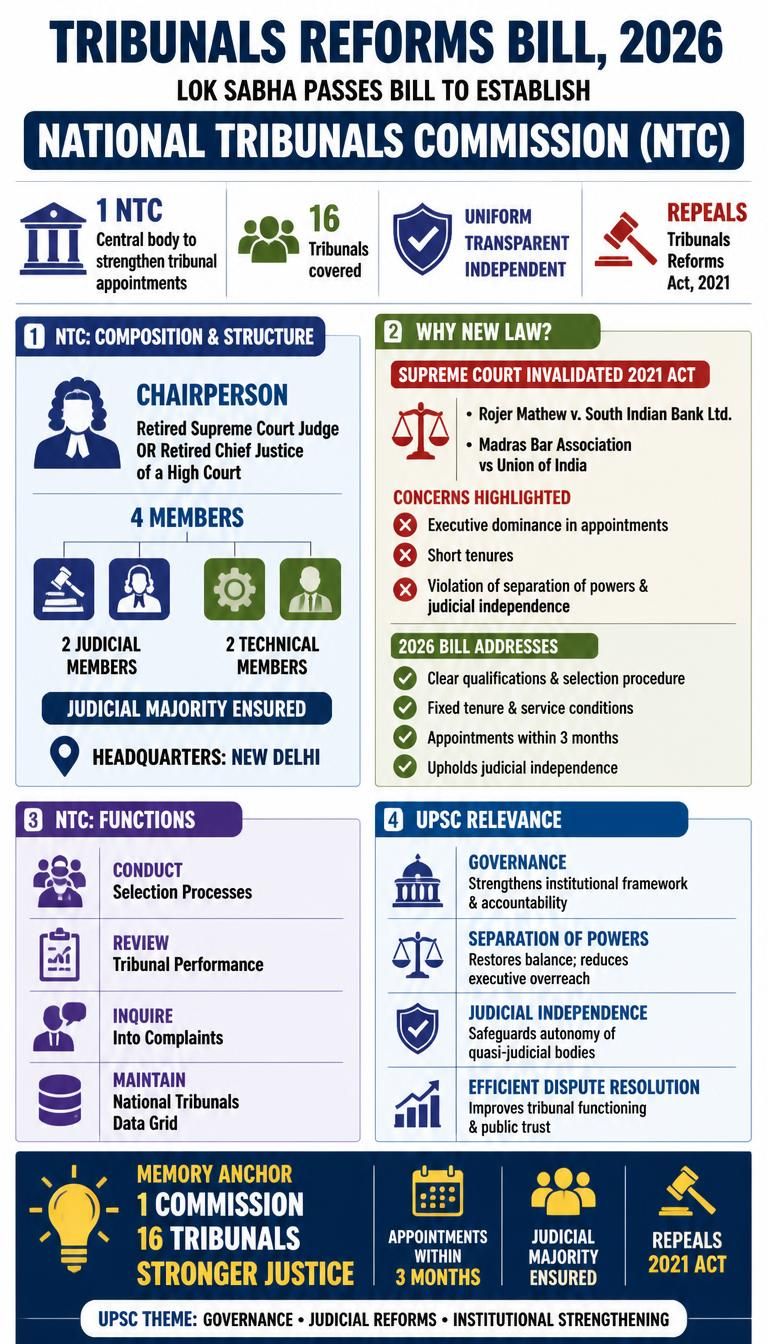
- The Tribunals Reforms Bill, 2026, was passed by the Lok Sabha to establish a National Tribunals Commission (NTC).
- The NTC is designed to oversee the appointment of chairpersons and members for 16 tribunals, aiming for uniformity, transparency, and independence.
- This new Bill repeals the Tribunals Reforms Act, 2021, which had several provisions struck down by the Supreme Court.
- The proposed Commission will be headquartered in New Delhi and headed by a retired Supreme Court judge or a retired Chief Justice of a High Court.
Tribunal Reforms.jpg
Detailed Insights:
- Union Law Minister Arjun Ram Meghwal introduced the Bill, which was passed by voice vote amidst Opposition protests on unrelated issues.
- The National Tribunals Commission will comprise a chairperson and four members, including two judicial and two technical experts, ensuring a judicial majority.
- The Supreme Court, in cases such as Rojer Mathew v. South Indian Bank Ltd. and Madras Bar Association vs Union of India, had invalidated provisions of the 2021 Act.
- The Court's rulings highlighted concerns over violations of the principles of separation of powers and judicial independence due to executive dominance in appointments and short tenures.
- The new legislation addresses these judicial concerns by providing for clear qualifications, selection procedures, tenure, and service conditions, and mandates appointments within three months.
- The NTC's functions will include conducting selection processes, reviewing tribunal performance, inquiring into complaints, and maintaining a National Tribunals Data Grid.
Key Concepts Involved:
- National Tribunals Commission (NTC): A statutory body established to centralize and professionalize the appointment, oversight, and administration of tribunal members.
- Tribunals: Quasi-judicial bodies established under Part XIV-A (Articles 323A and 323B) of the Constitution to resolve specific disputes, aiming for specialized and speedy justice.
- Separation of Powers: The constitutional principle dividing governmental powers among the legislative, executive, and judicial branches to prevent concentration of authority.
- Judicial Independence: The doctrine ensuring the judiciary's freedom from executive and legislative interference, crucial for impartial and fair justice delivery.

SuperKalam is your personal mentor for UPSC preparation, guiding you at every step of the exam journey.
Download the App


STUDY RESOURCES
CONTACT US
ⓒ Snapstack Technologies Private Limited