Behind Mecca story, Arab weakness and rise of three powers, Pg12
Mecca Accord highlights Arab weakness and rise of non-Arab powers like Turkey, Iran, Israel, urging India to expand military engagement in the Middle East.
Practice MCQs
862 Students attempted
Key Highlights:
- Saudi Arabia, Turkey, and Pakistan signed the Mecca Joint Defence Agreement on August 7, 2026, in Mecca.
- The agreement stipulates that an armed attack against any one of the three states will be regarded as an attack against them all, aiming to strengthen collective deterrence.
- This pact builds upon an earlier bilateral Strategic Mutual Defence Agreement between Saudi Arabia and Pakistan, signed in September 2025.
- The accord is seen as a response to regional instability, particularly the ongoing Iran war and Houthi attacks, and a hedge against perceived U.S. unreliability.
- The agreement reflects a historical pattern of Arab weakness in forming lasting regional security alliances, as highlighted by Huseyn Shaheed Suhrawardy's 1956 remark, "Zero plus zero plus zero still amounts to zero."
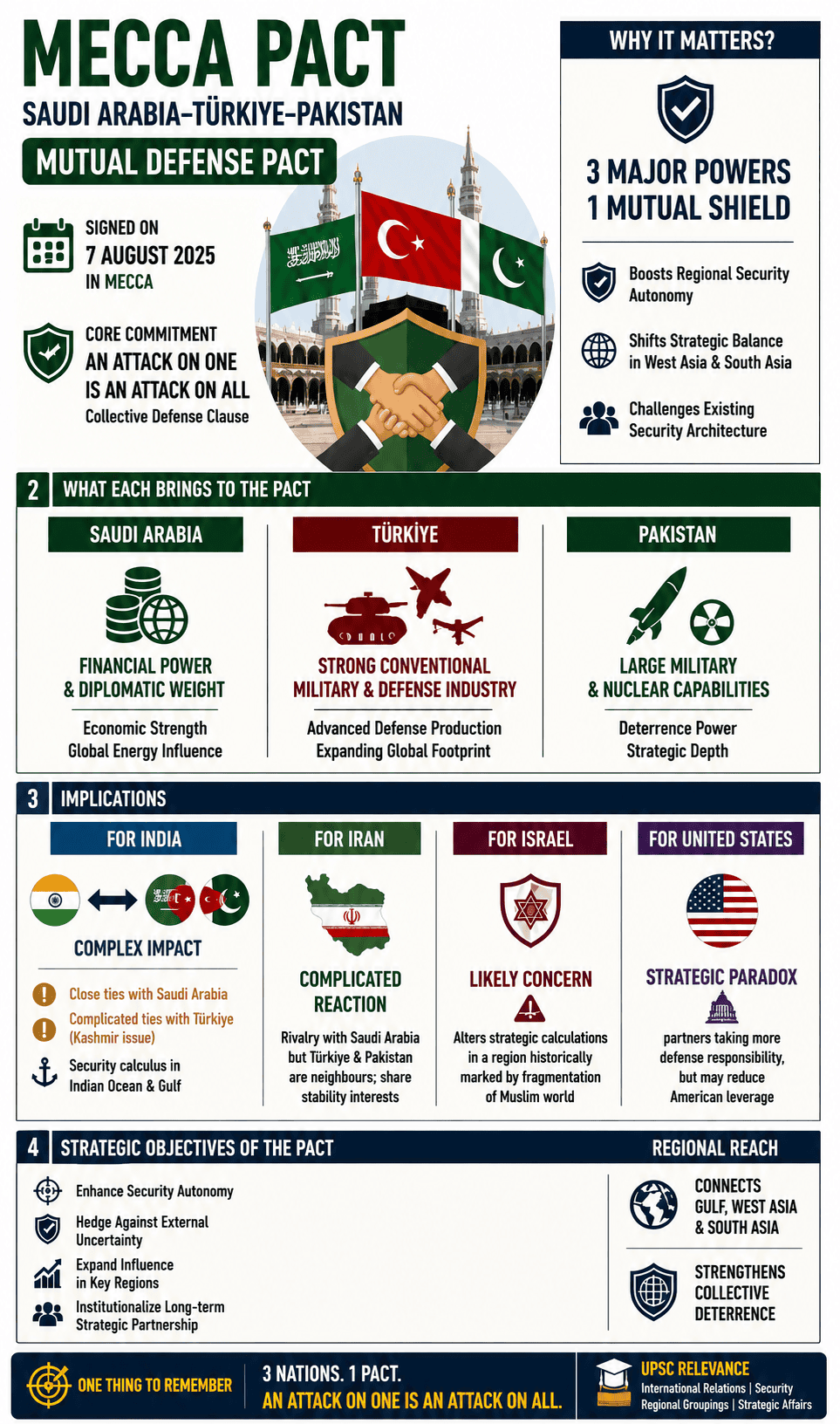
Mecca.jpg
Detailed Insights:
- The Mecca Joint Defence Agreement signifies a shift towards greater strategic autonomy for its signatories, seeking security options beyond traditional reliance on the U.S.
- Historically, attempts at Arab unity, such as the United Arab Republic (1958-1961), and regional alliances like the Baghdad Pact (later CENTO) and the Gulf Cooperation Council, have largely failed to achieve sustained collective security.
- The Baghdad Pact, formed in 1955, was a Cold War military alliance aimed at containing Soviet influence, but it dissolved in 1979 after Iraq's withdrawal and the Iranian Revolution.
- The Regional Cooperation for Development (RCD), established in 1964 by Iran, Turkey, and Pakistan, was an economic counterpart to CENTO and later became the Economic Cooperation Organisation (ECO) in 1985, but has achieved limited success.
- Saudi Arabia's inclusion of Turkey in the pact is notable, given past tensions, including the 2018 killing of Jamal Khashoggi, and Turkey's support for the Muslim Brotherhood, which Riyadh views as a threat.
- Pakistan's long-standing security cooperation with Saudi Arabia includes training and advice, but Islamabad maintained neutrality when Riyadh sought troops for the Yemen war in 2015.
- The U.S. has historically played a crucial role in Gulf security, reversing Iraq's annexation of Kuwait in 1991 and providing air and missile defense coordination against Iranian threats.
- India, historically a "passive bystander" in Middle Eastern security post-1947, is now encouraged to expand its military engagement and build capabilities for power projection in the region.
Key Concepts Involved:
- Mecca Joint Defence Agreement: A defense pact signed by Saudi Arabia, Turkey, and Pakistan on August 7, 2026, committing to collective defense.
- Baghdad Pact: A Cold War-era military alliance formed in 1955 by Turkey, Iraq, Great Britain, Pakistan, and Iran, aimed at containing Soviet expansion.
- Central Treaty Organisation (CENTO): The successor to the Baghdad Pact after Iraq's withdrawal in 1959, dissolved in 1979.
- United Arab Republic: A short-lived political union between Egypt and Syria from 1958 to 1961, an attempt at pan-Arab unity.
- Economic Cooperation Organisation (ECO): An intergovernmental organization founded in 1985 by Iran, Pakistan, and Turkey, succeeding the Regional Cooperation for Development (RCD), to promote economic, technical, and cultural cooperation.

SuperKalam is your personal mentor for UPSC preparation, guiding you at every step of the exam journey.
Download the App


STUDY RESOURCES
CONTACT US
ⓒ Snapstack Technologies Private Limited