Deepening ties, NASA invites ISRO to join its Moon Base programme, Pg3
NASA invites ISRO to join its Moon Base program, strengthening US-India space cooperation under the Artemis Accords for future lunar settlement.
Practice MCQs
862 Students attempted
Key Highlights:
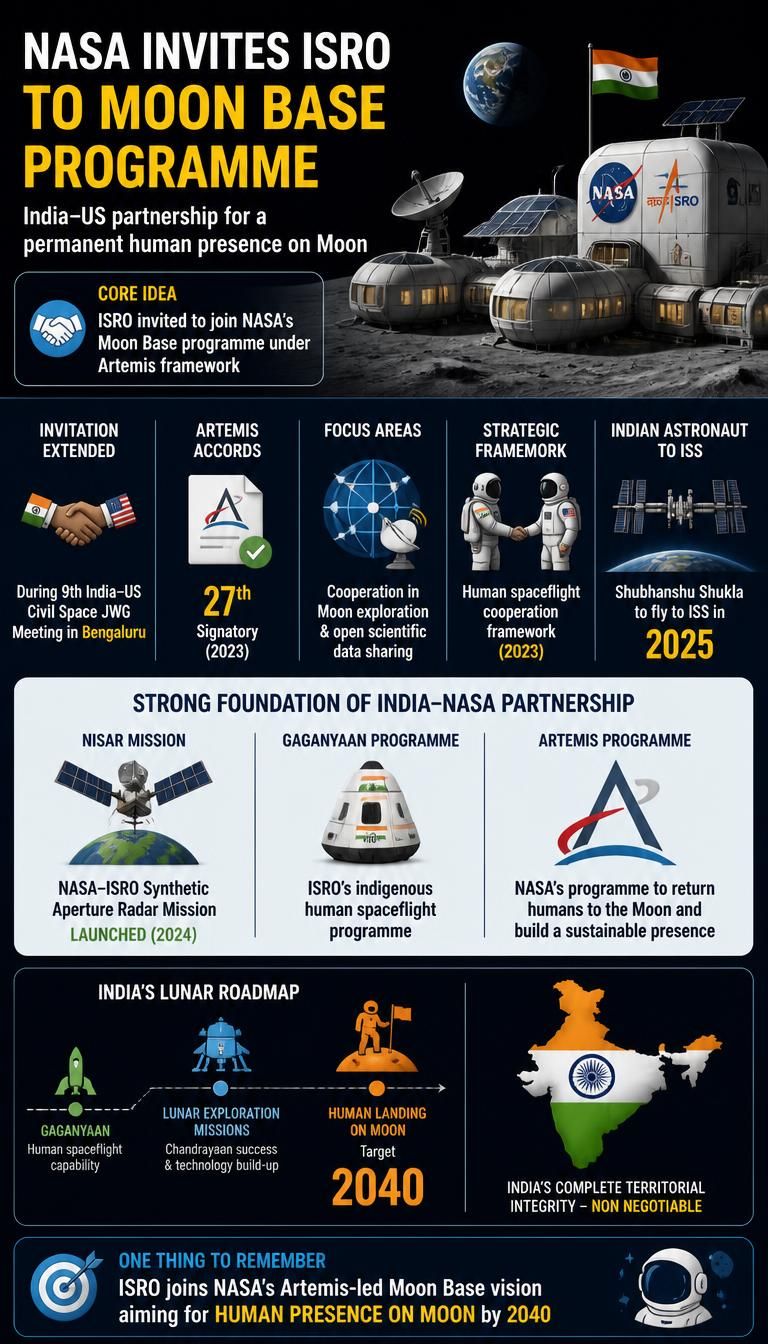
- NASA has invited ISRO to join its Moon Base programme, aiming for a permanent human settlement on the Moon.
- The invitation was extended during the ninth India-US Civil Space Joint Working Group meeting held in Bengaluru.
- India became the 27th signatory to the Artemis Accords in 2023, a US-led initiative for civil space exploration principles.
- This collaboration builds upon existing partnerships, including the NISAR (NASA-ISRO Synthetic Aperture Radar) mission and human spaceflight cooperation.
NASA ISRO.jpg
Detailed Insights:
- The Moon Base programme is an integral part of NASA's Artemis program, which seeks to return humans to the lunar surface.
- The Artemis Accords establish a common set of non-binding principles for the peaceful and sustainable exploration of outer space.
- Discussions at the joint working group also focused on advancing cooperation for open scientific data sharing under the Artemis Accords.
- A strategic framework for human spaceflight cooperation was established between India and the US in 2023.
- Indian astronaut Shubhanshu Shukla is scheduled to fly to the International Space Station (ISS) in 2025 as a result of this arrangement.
- The NISAR (NASA-ISRO Synthetic Aperture Radar) mission, launched last year, is a significant joint Earth-observing satellite venture.
- ISRO is also progressing with its indigenous Gaganyaan human spaceflight program.
- India aims to achieve a human landing on the Moon by the year 2040, complementing global lunar exploration efforts.
Key Concepts Involved:
- Artemis Accords: A set of non-binding principles guiding civil space exploration, particularly lunar, signed by multiple nations.
- NISAR (NASA-ISRO Synthetic Aperture Radar): A joint Earth-observing satellite mission designed to map global environmental changes.
- Gaganyaan: India's indigenous human spaceflight program aiming to send astronauts into low Earth orbit.
- International Space Station (ISS): A habitable artificial satellite in low Earth orbit, a collaborative project involving multiple space agencies.

SuperKalam is your personal mentor for UPSC preparation, guiding you at every step of the exam journey.
Download the App


STUDY RESOURCES
CONTACT US
ⓒ Snapstack Technologies Private Limited