Monsoon revived, but why there's cloud over the farm, Pg14
Monsoon revival boosts kharif sowing despite El Niño, yet rabi crops face uncertainty amid surging global food prices and India's agricultural import concerns.
Practice MCQs
862 Students attempted
Key Highlights:
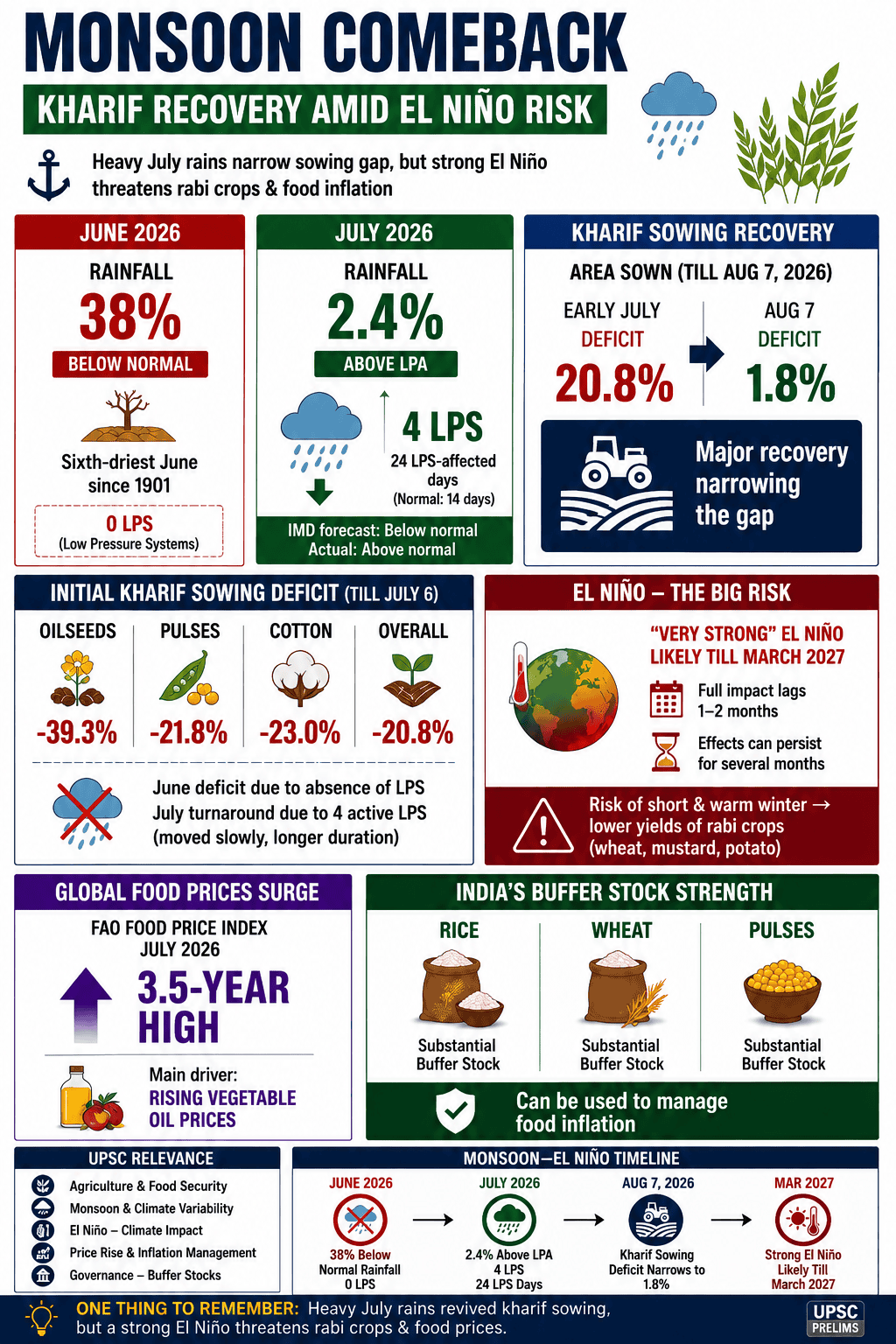
- The Southwest Monsoon revived significantly in July, narrowing the sowing gap for kharif crops despite a strengthening El Niño.
- June 2026 recorded 38% below normal rainfall, making it the sixth-driest June since 1901, with no low-pressure systems (LPS).
- July 2026 saw above-normal rainfall (2.4% above Long Period Average (LPA)) due to four active LPS, contrary to India Meteorological Department (IMD) forecasts.
- By August 7, the area sown under kharif crops was only 1.8% lower than the previous year, a substantial recovery from the 20.8% deficit in early July.
- Concerns persist for kharif yields in August-September and the upcoming rabi crops due to the potential for a "very strong" El Niño persisting until March 2027.
- The United Nations’ Food and Agriculture Organization (FAO) Food Price Index reached a three-and-a-half-year high in July, primarily driven by rising vegetable oil prices.
- India holds substantial buffer stocks of rice, wheat, and pulses, which can be utilized to manage potential food inflation.
Monsoon.png
Detailed Insights:
- Initial kharif sowing till July 6 showed a significant deficit, particularly for oilseeds (39.3%), pulses (21.8%), and cotton (23%).
- The deficient June rainfall was attributed to the absence of low-pressure systems (LPS), which typically bring rain.
- The July turnaround was due to four LPS that moved slowly and had longer durations, leading to 24 LPS-affected days compared to the normal 14.
- The IMD had forecast "most likely to be below normal" rainfall for July, making the actual above-normal rainfall a significant deviation.
- The full impact of El Niño on rainfall and temperatures typically has a lag of 1-2 months and can extend over several months.
- A prolonged and strong El Niño could lead to a relatively short and warm winter, negatively impacting yields of rabi crops like wheat, mustard, and potato.
- The rise in the FAO Food Price Index was largely driven by vegetable oils, with the vegetable oils index up 17.3% year-on-year.
- Increased international petroleum prices incentivize the diversion of palm, rapeseed, and soybean oil for biofuel production, contributing to higher vegetable oil prices.
- India's public godowns held 92.6 million tonnes of rice and wheat on July 1, significantly exceeding the required minimum of 41.1 million tonnes.
Key Concepts Involved:
- Southwest Monsoon: The primary rainy season in India, crucial for agriculture, occurring from June to September.
- Kharif Crops: Crops sown with the onset of the Southwest Monsoon, typically harvested in autumn (e.g., rice, maize, cotton, pulses).
- Rabi Crops: Crops sown in winter and harvested in spring (e.g., wheat, barley, mustard, potato).
- El Niño: A climate pattern characterized by the unusual warming of surface waters in the central and eastern equatorial Pacific Ocean, impacting global weather.
- Low-Pressure Systems (LPS): Weather systems associated with cyclonic circulation that bring significant rainfall to the Indian subcontinent.
- Long Period Average (LPA): A benchmark representing the average rainfall over a specific period (e.g., 50 years), used to assess monsoon performance.
- India Meteorological Department (IMD): The principal agency responsible for meteorological observations, weather forecasting, and seismology in India.
- United Nations’ Food and Agriculture Organization (FAO) Food Price Index: A measure of the monthly change in international prices of a basket of food commodities.

SuperKalam is your personal mentor for UPSC preparation, guiding you at every step of the exam journey.
Download the App


STUDY RESOURCES
CONTACT US
ⓒ Snapstack Technologies Private Limited