The Mecca Pact and the Rise of Strategic Hedging, Pg6
Saudi Arabia, Türkiye, and Pakistan sign Mecca Pact, forming a new mutual defense alliance, signaling a shift towards regional strategic autonomy and hedging against external dependence.
Practice MCQs
862 Students attempted
Key Highlights:
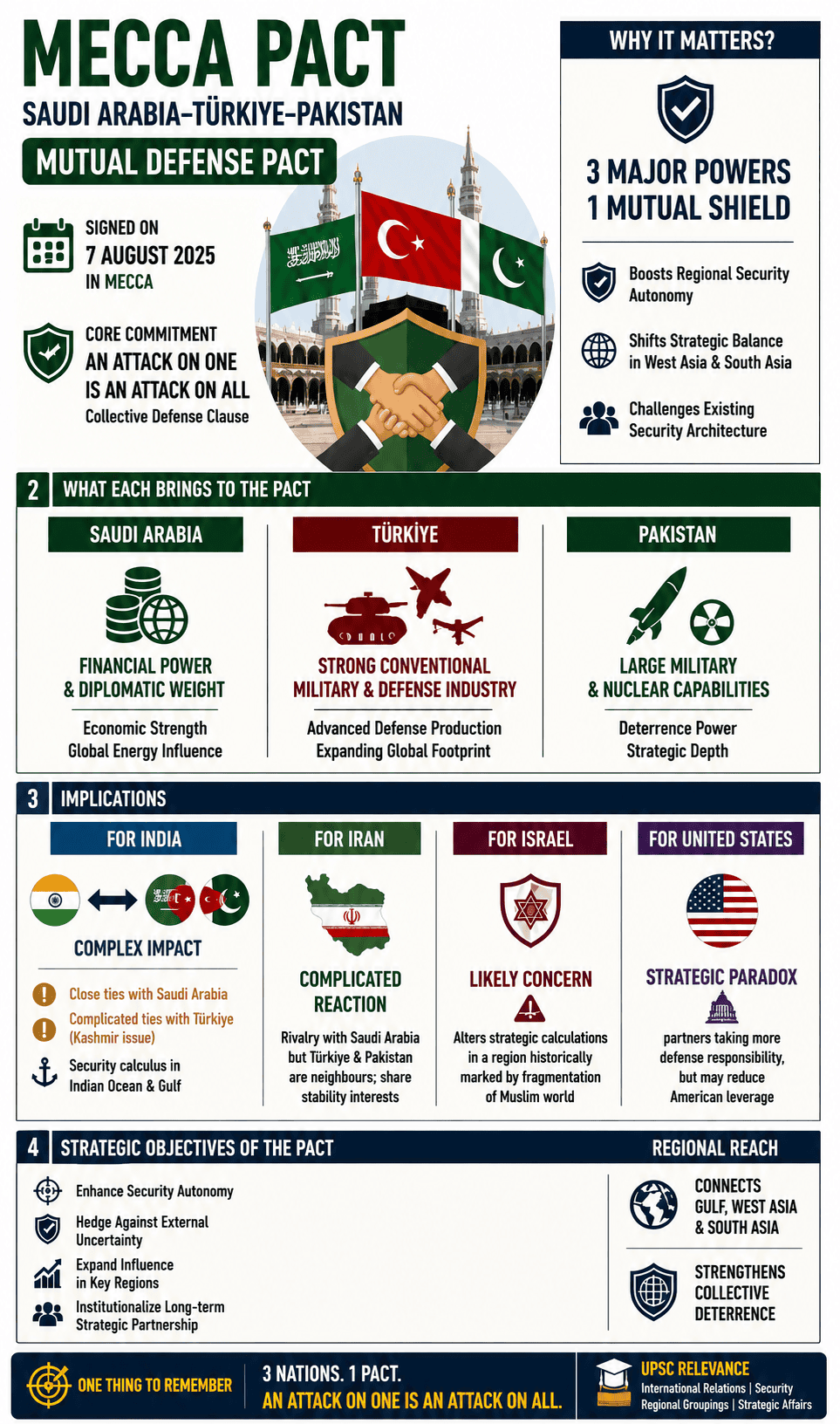
- Saudi Arabia, Türkiye, and Pakistan signed the Mecca Pact, a mutual defense agreement, in Mecca on August 7.
- The pact stipulates that an attack on one member will be considered an attack on all three.
- The agreement signifies a growing determination among these regional powers to supplement existing external security guarantees with their own arrangements.
- Saudi Arabia contributes financial resources and political influence, Türkiye offers a strong conventional military and defense industry, and Pakistan provides a large military and nuclear capabilities.
Mecca.jpg
Detailed Insights:
- The Mecca Pact represents a strategic hedging approach by the three nations, aiming to enhance their security autonomy.
- For Saudi Arabia, the pact offers strategic insurance against over-reliance on a single external guarantor, particularly after past attacks on its oil installations.
- Türkiye views the agreement as a means to achieve strategic autonomy and expand its influence into the Gulf and South Asia, leveraging its growing defense industry.
- Pakistan aims to widen its strategic horizons beyond its traditional rivalry with India and institutionalize its close relations with Saudi Arabia and Türkiye.
- The pact's implications for India are complex, given its close ties with Saudi Arabia but complicated relations with Türkiye over issues like Kashmir.
- Iran's reaction is complicated, as Türkiye and Pakistan share borders and interests in regional stability, despite the Saudi-Iranian rivalry.
- Israel is likely to view the development with concern, as it alters the strategic calculations in a region historically marked by the fragmentation of the Muslim world.
- The United States faces a paradox, as it has long advocated for regional partners to take more responsibility for their defense, but this could diminish American leverage.
Key Concepts Involved:
- Strategic Hedging: A foreign policy approach where a state seeks to balance its reliance on a primary security partner with developing alternative security arrangements.
- Strategic Autonomy: The capacity of a state to act independently in its foreign and security policy, free from external influence or dependence.
- Mutual Defense Agreement: A treaty between two or more states that commits them to support each other in case of an attack.

SuperKalam is your personal mentor for UPSC preparation, guiding you at every step of the exam journey.
Download the App


STUDY RESOURCES
CONTACT US
ⓒ Snapstack Technologies Private Limited