A timely reset for the Food Security Act, Pg6
India debates crucial reforms to the National Food Security Act, aiming to balance food access with nutritional adequacy and address the double burden of malnutrition.
Practice MCQs
869 Students attempted
Key Highlights:
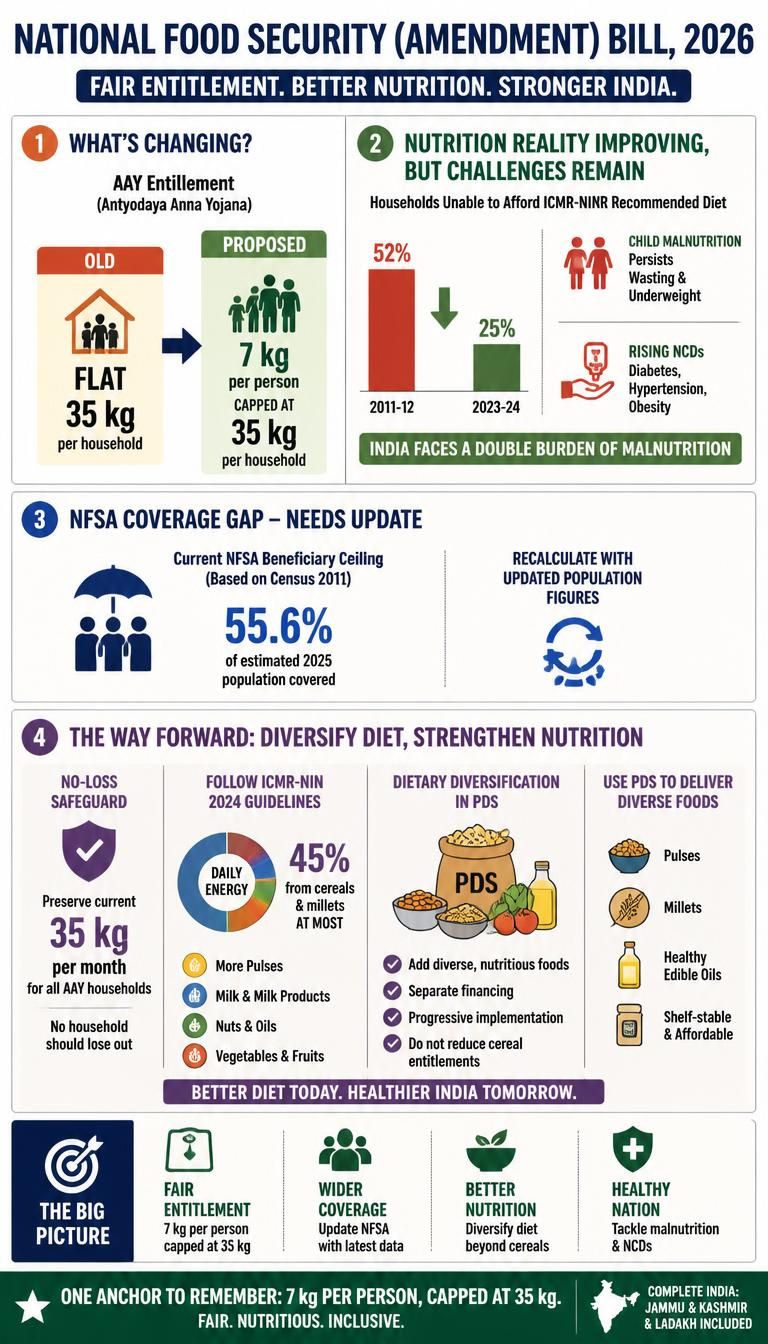
- The proposed National Food Security (Amendment) Bill, 2026 aims to link Antyodaya Anna Yojana (AAY) entitlements to household size, suggesting 7 kg per person capped at 35 kg.
- India's household consumption survey indicates a significant drop in the share of households unable to afford the ICMR-National Institute of Nutrition (NIN) recommended diet, from 52% in 2011-12 to 25% in 2023-24.
- The current NFSA beneficiary ceiling, based on Census 2011, covers only 55.6% of the estimated 2025 population, necessitating recalculation with updated figures.
- India faces a "double burden of malnutrition," with persistent child wasting and underweight alongside a rising prevalence of non-communicable diseases like diabetes.
- The article advocates for dietary diversification within the Public Distribution System (PDS) and linking it with complementary nutrition programs.
NFSA.jpg
Detailed Insights:
- The existing AAY provides a flat 35 kg per household, which can lead to lower per-person entitlements for larger families compared to Priority Households.
- An explicit "no-loss safeguard" is recommended to preserve the current 35 kg monthly entitlement for all AAY households, preventing reduced support for smaller families.
- The ICMR-NIN 2024 guidelines suggest that cereals and millets should provide at most 45% of daily energy, emphasizing increased intake of pulses, milk, nuts, vegetables, and fruits.
- Dietary diversification should be separately financed and progressively implemented without reducing existing cereal entitlements, to address nutritional imbalances.
- The Public Distribution System (PDS) can be utilized to supply affordable, shelf-stable diverse foods such as pulses, millets, and healthy edible oils.
- Complementary programs like Anganwadi services and Pradhan Mantri Poshan Shakti Nirman (PM POSHAN) are crucial for integrating food, nutrition, and health systems.
- Fair Price Shops can serve as points for providing last-mile nutrition information and facilitating referrals to government health services for NCD screenings.
- The One Nation One Ration Card system has significantly enhanced the portability and monitoring of NFSA benefits, covering nearly all beneficiaries.
Key Concepts Involved:
- National Food Security Act (NFSA): A 2013 Act that legally entitles up to 75% of the rural population and 50% of the urban population to receive subsidized food grains.
- Antyodaya Anna Yojana (AAY): A scheme under NFSA providing highly subsidized food grains to the poorest of the poor households.
- Public Distribution System (PDS): A government-sponsored chain of shops that distributes essential commodities like food grains, sugar, and kerosene at subsidized prices.
- ICMR-National Institute of Nutrition (NIN): A premier research institute under the Indian Council of Medical Research that formulates dietary guidelines and conducts nutrition research.
- One Nation One Ration Card: A scheme allowing NFSA beneficiaries to claim their food grains from any Fair Price Shop across the country using their existing ration card.
- Pradhan Mantri Poshan Shakti Nirman (PM POSHAN): A centrally sponsored scheme providing hot cooked meals to school children, aimed at improving nutritional outcomes.
- Minimum Support Price (MSP): A guaranteed price set by the Government of India for certain agricultural crops to protect farmers from market price fluctuations.

SuperKalam is your personal mentor for UPSC preparation, guiding you at every step of the exam journey.
Download the App


STUDY RESOURCES
CONTACT US
ⓒ Snapstack Technologies Private Limited