GS 3: EconomyGS 3: Science & TechnologyGS 2: GovernancePrelimsGS2: Government policies and interventions for development in various sectorsGS2: Effect of Policies and Politics of Developed and Developing Countries on India's InterestsGS3: Buffer Stocks and Food SecurityGS3: Infrastructure: Energy, Ports, Roads, Airports, Railways etc.
How sustainable is India’s E20 push?, Pg8
India's E20 ethanol blending program faces sustainability questions regarding vehicle compatibility, food security, and economic benefits amidst government's ambitious energy transition.
Practice MCQs
869 Students attempted
Key Highlights:
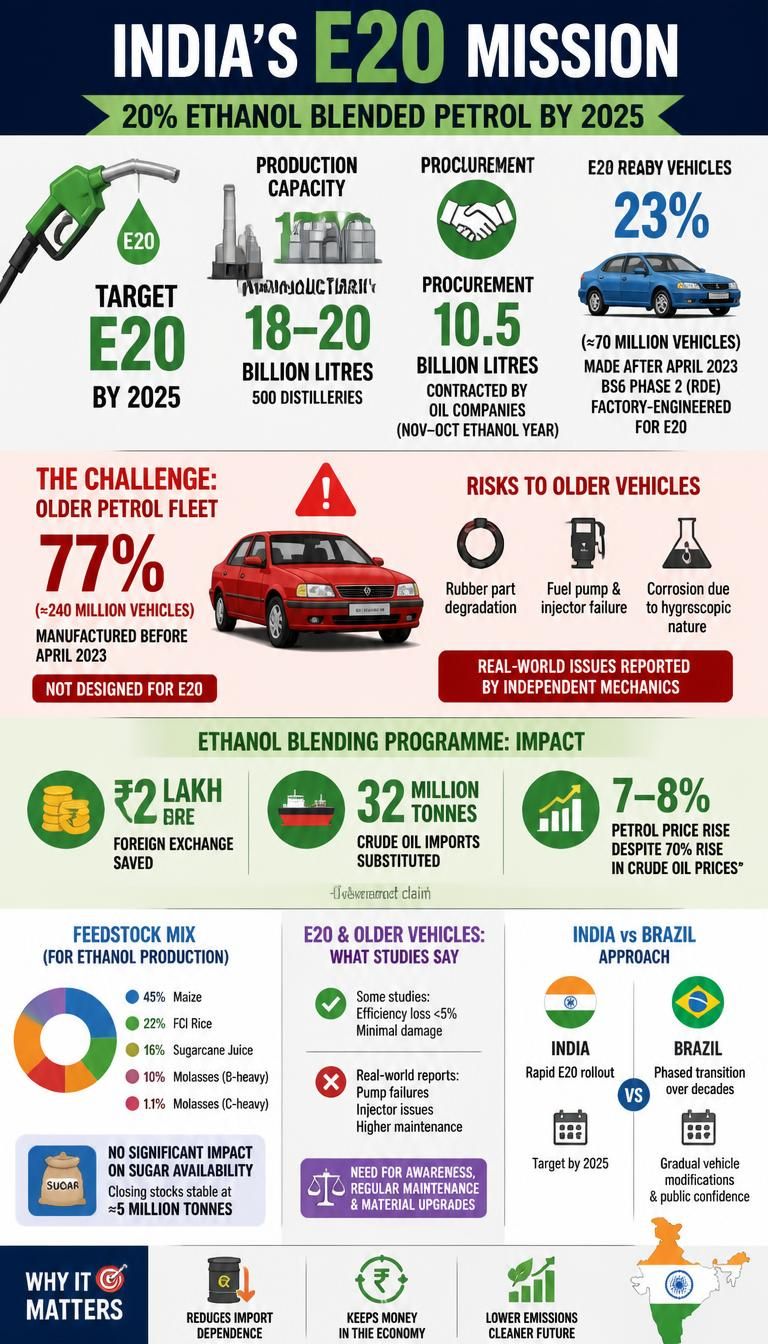
- India aims for E20 (20% ethanol blended petrol) by 2025, with current production capacity at 18-20 billion litres from 500 distilleries.
- Oil companies have contracted to procure 10.5 billion litres of ethanol for the current ethanol year (November-October).
- Vehicles manufactured after April 2023, compliant with Bharat Stage 6 Phase 2 (Real Driving Emissions), are factory-engineered for E20.
- Approximately 77% of India's petrol fleet (240 million vehicles) are older models not designed for E20, raising concerns about potential damage and maintenance issues.
- The government claims the Ethanol Blending Programme has saved around ₹2 lakh crore in foreign exchange and substituted 32 million tonnes of crude oil imports.
E20 Mission.jpg
Detailed Insights:
- The Ethanol Blending Programme (EBP) aims to reduce India's reliance on crude oil imports and channel money into the domestic economy.
- Feedstocks for ethanol production include maize (45%), FCI rice (22%), sugarcane juice (16%), and molasses (B-heavy 10%, C-heavy 1.1%).
- Diversion of sugarcane products to ethanol has not significantly impacted sugar availability, with closing stocks remaining stable at around 5 million tonnes.
- Concerns exist regarding the impact of E20 on older vehicles, as ethanol is a polar solvent and hygroscopic, potentially degrading rubber components and causing corrosion.
- While some studies suggest minimal damage and efficiency loss (under 5%), independent mechanics report real-world issues like fuel pump and injector failures in older vehicles.
- India's rapid E20 rollout contrasts with Brazil's phased transition over decades, which allowed for gradual vehicle modifications and public confidence building.
- The government states that despite a 70% rise in crude oil prices, petrol pump prices increased by only 7-8%, attributing this stability partly to the EBP.
Scientific/Technical Concepts Involved:
- E20: A blend of 20% ethanol and 80% petrol, designed to reduce fossil fuel consumption and emissions.
- Bharat Stage 6 Phase 2 (Real Driving Emissions): An emission standard for vehicles in India, mandating E20 compatibility for new vehicles from April 2023.
- Hygroscopic: A property of a substance to absorb moisture from the atmosphere, which in ethanol can lead to water separation and corrosion in fuel systems.
- Polar Solvent: A type of solvent that can dissolve polar compounds, and in the context of ethanol, can degrade non-polar materials like certain rubber and plastic components in older vehicles.

SuperKalam is your personal mentor for UPSC preparation, guiding you at every step of the exam journey.
Download the App


STUDY RESOURCES
CONTACT US
ⓒ Snapstack Technologies Private Limited