RBI Proposes New Loan Interest-Rate Framework, Pg17
RBI proposes a comprehensive new loan interest-rate framework with tighter rules for floating-rate loans, enhancing transparency and borrower safeguards for financial institutions.
Practice MCQs
869 Students attempted
Key Highlights:
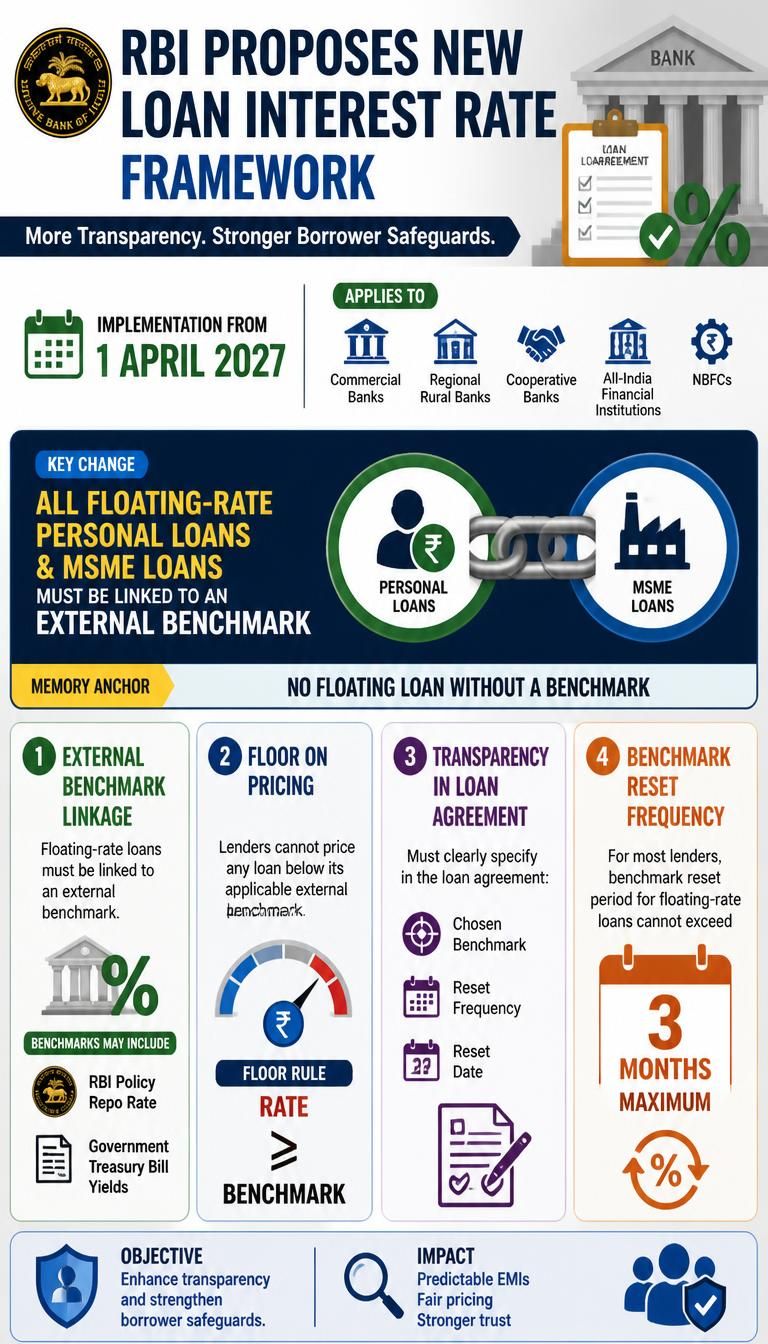
- The Reserve Bank of India (RBI) has proposed a new framework for interest rates on loans and advances.
- The Draft Reserve Bank of India (Interest Rates on Loans and Advances) Directions, 2026, aims to enhance transparency and borrower safeguards.
- This new framework is slated to be implemented from April 1, 2027.
- It will encompass commercial banks, regional rural banks, cooperative banks, all-India financial institutions, and Non-Banking Financial Companies (NBFCs).
- A significant change mandates linking all floating-rate personal loans and Micro, Small and Medium Enterprises (MSMEs) loans to an external benchmark.
RBI.jpg
Detailed Insights:
- The proposed directions will apply to the domestic operations of all specified financial entities.
- Loans can be offered at either fixed or floating rates, with interest typically calculated on a daily reducing balance.
- External benchmarks for floating rates may include the RBI policy repo rate or Government Treasury Bill yields.
- Lenders will be prohibited from pricing any loan below its applicable external benchmark.
- The chosen benchmark, its reset frequency, and the reset date must be clearly specified in loan agreements.
- For most lenders, the benchmark reset period for floating-rate loans cannot exceed three months.
- Once selected, the external benchmark cannot be altered during the entire tenure of the loan.
- Agricultural loans will feature separate provisions specifically linked to crop seasons.
Key Concepts Involved:
- Floating-rate loan: An interest rate that changes over the life of the loan based on an underlying benchmark.
- External benchmark: A publicly available and transparent reference rate used to determine loan interest rates.
- Repo rate: The rate at which the Reserve Bank of India lends money to commercial banks.
- Non-Banking Financial Company (NBFC): A financial institution that does not have a banking license but provides banking services.

SuperKalam is your personal mentor for UPSC preparation, guiding you at every step of the exam journey.
Download the App


STUDY RESOURCES
CONTACT US
ⓒ Snapstack Technologies Private Limited