GS 3: Science & TechnologyGS 2: International RelationsPrelimsGS2: Bilateral, Regional and Global Groupings and AgreementsGS2: Effect of Policies and Politics of Developed and Developing Countries on India's InterestsGS3: Indigenization of Technology and New Technology DevelopmentGS3: Space Technology
The next step to the Moon, Pg14
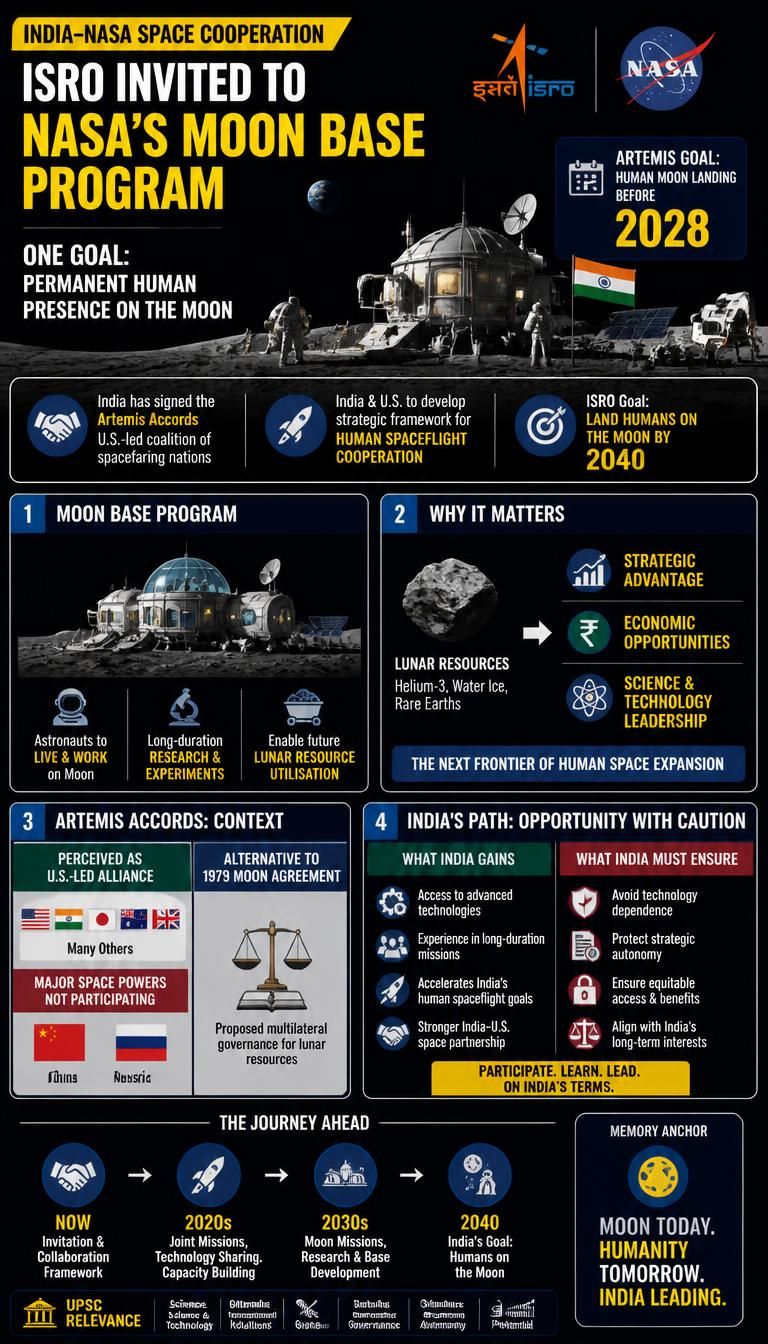
NASA invites ISRO to join its ambitious Moon Base program, marking a significant step in India-US space cooperation and lunar exploration.
Practice MCQs
869 Students attempted
Key Highlights:
- NASA has invited ISRO to join its Moon Base program, an initiative to establish a permanent research station on the Moon.
- The Moon Base program is a follow-up to the Artemis program, which aims to land humans on the Moon before 2028.
- India has already signed the Artemis Accords, a U.S.-led coalition of spacefaring nations.
- India and the U.S. have agreed to develop a strategic framework for human spaceflight cooperation.
- ISRO aims to land humans on the Moon by 2040, and participation could provide valuable experience and technology access.
ISRO.jpg
Detailed Insights:
- The Moon Base program seeks to enable astronauts to live, work, and conduct experiments on the Moon for extended periods.
- The exploration of the Moon is gaining strategic and economic importance due to potential lunar resource extraction.
- The Artemis Accords are perceived by some as a U.S.-led alliance, with major space powers like China and Russia not participating.
- The Artemis Accords are seen as an alternative to the 1979 Moon Agreement, which proposed a multilateral governance framework for lunar resources.
- India's participation in the Moon Base program could accelerate its own human spaceflight goals but requires careful navigation to avoid technology dependence.
Key Concepts Involved:
- Artemis Accords: A U.S.-led international agreement establishing principles for lunar exploration and resource utilization.
- Moon Agreement: A 1979 United Nations treaty aiming to establish an international regime for governing the Moon and its natural resources.
- Moon Base program: A proposed initiative by NASA to build a permanent human research outpost on the lunar surface.

SuperKalam is your personal mentor for UPSC preparation, guiding you at every step of the exam journey.
Download the App


STUDY RESOURCES
CONTACT US
ⓒ Snapstack Technologies Private Limited