Total solar eclipse: The best time to study Sun's 'invisible' part, Pg4
Scientists leverage rare total solar eclipse to study Sun's elusive corona, revealing magnetic structures that cause disruptive solar flares.
Practice MCQs
869 Students attempted
Key Highlights:
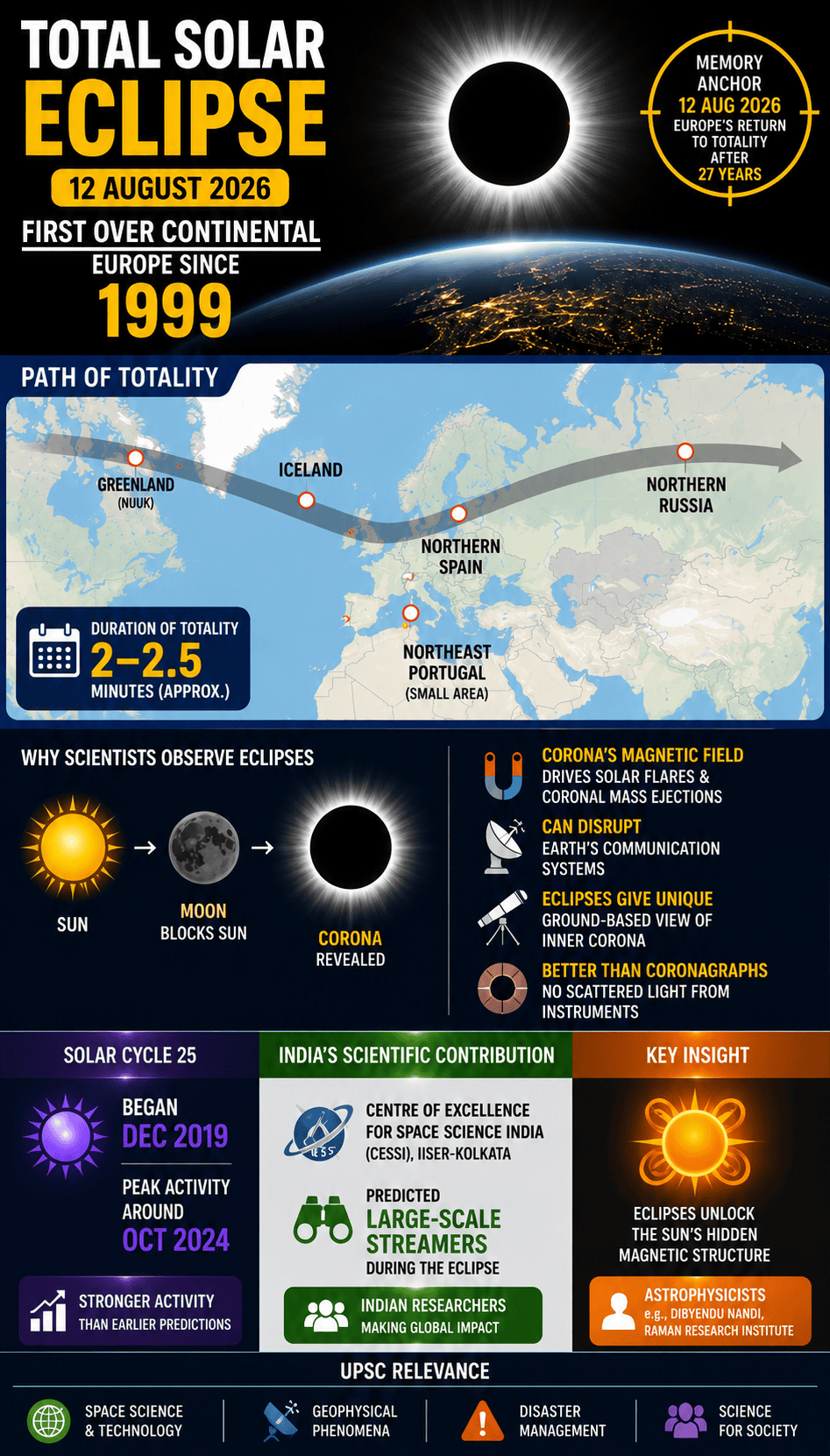
- Europe witnessed a total solar eclipse on August 12, 2026, marking its first such event in continental Europe since 1999.
- The eclipse's path of totality traversed parts of Greenland, Iceland, northern Spain, a small area in northeast Portugal, and northern Russia.
- Scientists utilize total solar eclipses to study the Sun's faint outer atmosphere, the corona, which is otherwise obscured by the bright solar disc.
- Indian researchers from the Centre of Excellence for Space Science India (CESSI), IISER-Kolkata, predicted the visibility of large-scale streamers during the event.
- The eclipse occurred during Solar Cycle 25, which began in December 2019 and has already passed its maximum activity phase.
Solar Eclipse.jpg
Detailed Insights:
- A total solar eclipse occurs when the Moon perfectly aligns between the Sun and Earth, completely blocking the Sun's light and revealing its corona.
- The corona is crucial for study as its magnetic field drives phenomena like solar flares and coronal mass ejections, which can disrupt Earth's communication systems.
- Normally, specialized instruments called coronagraphs are used to artificially block the Sun's disc for corona observation, but they can be affected by scattered light.
- The natural blocking by the Moon during an eclipse provides a unique opportunity for ground-based observations of the inner corona.
- The current Solar Cycle 25 has shown stronger activity than initially predicted, with its peak occurring around October 2024, making the eclipse a valuable observation period.
- Astrophysicists like Dibyendu Nandi from the Raman Research Institute emphasize that eclipses offer insights into the Sun's underlying magnetic structure.
- The predicted large-scale streamers are bright magnetic field structures rooted in the solar surface, offering a rare chance to observe the Sun's magnetic fields directly.
Scientific/Technical Concepts Involved:
- Solar Eclipse: An astronomical event where the Moon passes between the Sun and Earth, casting a shadow on Earth and blocking the Sun's light.
- Corona: The Sun's outermost atmosphere, extending millions of kilometers into space, visible during a total solar eclipse.
- Coronagraph: An instrument designed to block the direct light from a star, allowing observation of its faint surrounding corona.
- Solar Cycle: An approximately 11-year cycle during which the Sun's activity, marked by sunspots and solar flares, rises and falls.

SuperKalam is your personal mentor for UPSC preparation, guiding you at every step of the exam journey.
Download the App


STUDY RESOURCES
CONTACT US
ⓒ Snapstack Technologies Private Limited