IMD’s April forecast projects monsoon to be ‘below normal’ for first time in 11 years, Pg1
IMD forecasts 'below-normal' monsoon for India after 11 years, with 92% LPA rainfall expected, raising concerns for agriculture.
Practice MCQs
847 Students attempted
Key Highlights:
- The IMD forecasts a "below-normal" southwest monsoon for India in 2026, projecting only 92% of the LPA (87 cm) rainfall during June-September.
- This is the first time in 11 years that the IMD's April forecast has predicted below-normal monsoon rainfall.
- The primary reason cited is the anticipated development of an El Nino, which is the periodic warming of the Central Equatorial Pacific.
- Insufficient rain, coupled with potential fertilizer supply disruptions, could negatively impact farming, especially in rainfed areas.
Detailed Insights:
- India last experienced reduced monsoon rainfall in 2023, with the IMD forecasting "near-normal" rainfall at 96% of the LPA.
- The development of a positive Indian Ocean Dipole (IOD) and reduced northern hemisphere snow cover could potentially mitigate the negative impacts of El Nino on the monsoon.
- The IOD refers to sea-surface temperature oscillations between the western and eastern tropical Indian Ocean, with a positive dipole generally favoring increased rainfall in India.
- The IMD will update its monsoon forecast in May, but historical data reveals instances where initial forecasts of normal monsoon turned into drought situations.
- Years of surplus monsoon were recorded in 2024 and 2025, and save for 2023, India has received "normal" or excess rainfall in all years since 2020.
How UPSC asks Questions on this:
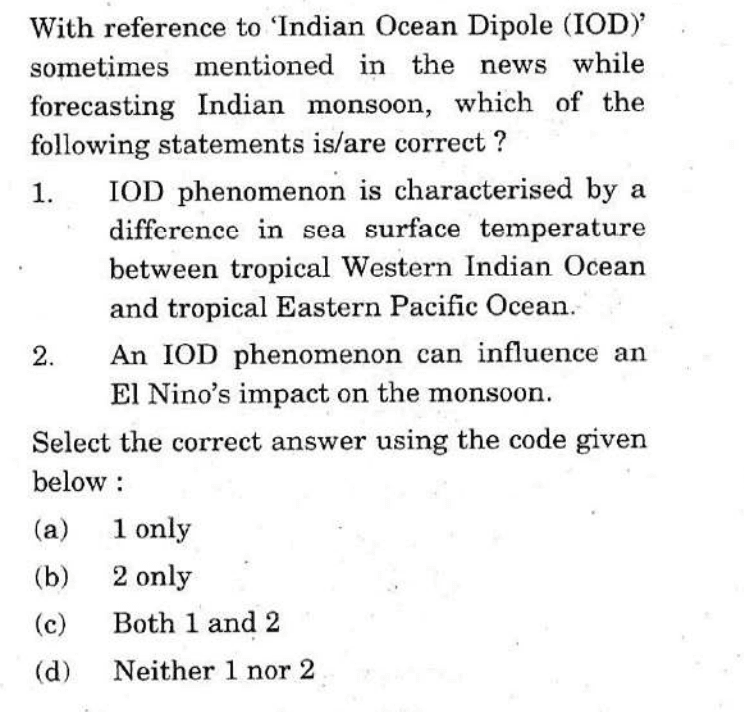
UPSC Prelims 2017
Scientific/Technical Concepts Involved:
- El Nino: Periodic warming of the Central Equatorial Pacific Ocean, often associated with weaker monsoon rains in India.
- La Nina: The converse of El Nino, characterized by cooler-than-average sea surface temperatures in the central and eastern tropical Pacific Ocean.
- Indian Ocean Dipole (IOD): Oscillation of sea surface temperatures between the western and eastern tropical Indian Ocean, influencing rainfall patterns in the region.
- Long Period Average (LPA): The average rainfall over a long period, used as a benchmark for assessing monsoon performance.

SuperKalam is your personal mentor for UPSC preparation, guiding you at every step of the exam journey.
Download the App


STUDY RESOURCES
CONTACT US
ⓒ Snapstack Technologies Private Limited