NHPC’s own paper detailed gas fires in Teesta-VI tunnels before fatal blast, Pg14
NHPC's own paper detailed repeated flammable gas fires in Teesta-VI tunnels before fatal methane blast killed 15 workers.
Practice MCQs
753 Students attempted
Key Highlights:
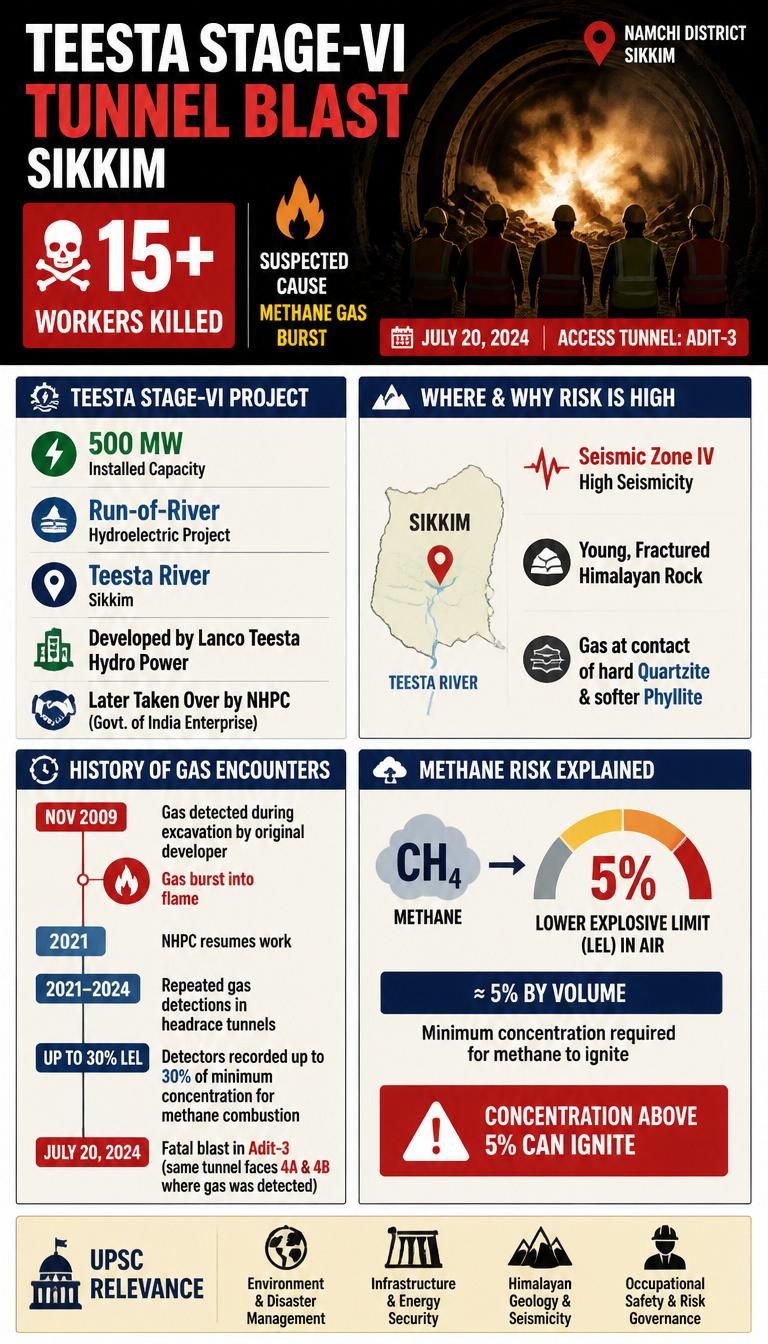
- A fatal blast occurred in a Teesta Stage-VI Hydroelectric Project tunnel in Sikkim's Namchi district, killing at least 15 workers.
- The explosion on July 20 is suspected to have been caused by a sudden burst of methane gas.
- An internal paper by NHPC engineers, presented at EUROENGEO 2024, had previously detailed repeated encounters with flammable gas and fires in the project's headrace tunnels since 2009.
- The paper noted gas detection at the contact between hard quartzite and softer phyllite in the young, fractured Himalayan rock, which is located in Seismic Zone IV.
Tunnel Blast.jpg
Detailed Insights:
- The Teesta Stage-VI Hydroelectric Project is a 500 MW run-of-river facility on the Teesta River in Sikkim, initially developed by Lanco Teesta Hydro Power and later taken over by NHPC.
- The blast occurred in an access tunnel, Adit-3, which leads to the same tunnel faces (4A and 4B) where flammable gas was previously detected.
- The NHPC paper highlighted that gas was first detected in November 2009, bursting into flame during excavation by the original developer.
- After NHPC resumed work in 2021, gas was again reported, with detectors recording up to 30% of the minimum concentration required for methane combustion.
- The Lower Explosive Limit (LEL) for methane in air is approximately 5% by volume, meaning concentrations above this can ignite.
- The project's tunnels traverse geologically challenging terrain in the Himalayas, characterized by young, fractured rock and carbon-rich phyllite.
- Seismic Zone IV denotes a high damage risk zone, indicating the region's susceptibility to strong earthquakes due to active tectonic movements.
- The paper also documented extensive instability and collapses in previously constructed sections of the tunnels, underscoring the geological complexities of the site.
Scientific/Technical Concepts Involved:
- Headrace tunnel: A crucial component in hydroelectric projects that conveys water from the intake to the power plant's turbines.
- Methane: A colorless, odorless, flammable gas, often found trapped in carbon-rich geological formations, posing an explosion risk in confined spaces.
- Seismic Zone IV: A classification for regions in India with a high risk of earthquake damage, requiring stringent construction standards.
- Phyllite: A fine-grained metamorphic rock, often found in the Himalayas, which can be carbon-rich and associated with trapped gases.
- Quartzite: A hard, non-foliated metamorphic rock formed from sandstone, often found in contact with phyllite in Himalayan geology.

SuperKalam is your personal mentor for UPSC preparation, guiding you at every step of the exam journey.
Download the App


STUDY RESOURCES
CONTACT US
ⓒ Snapstack Technologies Private Limited