State Forest Departments across India have no record of African grey parrot trade, reveal RTI responses, Pg14
RTI reveals illegal trade of endangered African grey parrots thriving due to lack of state oversight and enforcement.
Practice MCQs
782 Students attempted
Key Highlights:
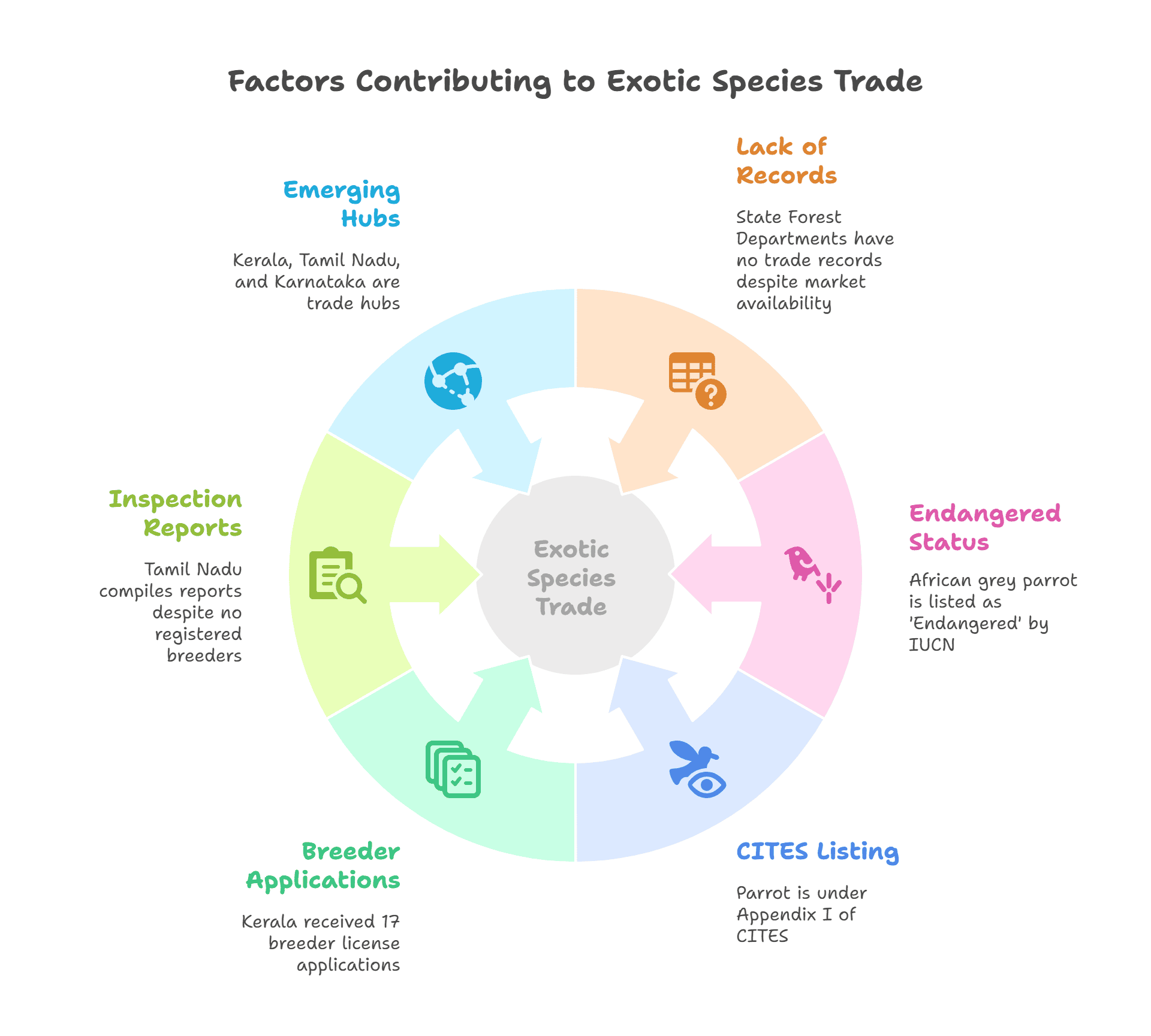
- Indian State Forest Departments possess no records of African grey parrot trade, despite their availability in pet markets.
- The African grey parrot is listed under Appendix I of CITES and as 'Endangered' by the IUCN.
- Only Kerala's Forest Department reported receiving 17 applications for breeder licenses.
- Tamil Nadu Forest Department is compiling inspection reports despite claiming no registered breeders.
- Kerala, Tamil Nadu, and Karnataka are emerging as hubs for exotic species trade.
Factors Contributing to Exotic Species Trade.png
Detailed Insights:
- The African grey parrot (Psittacus erithacus) requires special permits for trade, including CITES registration and import certificates.
- Extensive capture for the pet trade has decimated African grey parrot populations in Central Africa.
- Breeding CITES Appendix I species requires a valid breeding license under the Breeders of Species Licence Rules, 2023.
- Obtaining a breeding license requires a CITES import permit, a Directorate-General of Foreign Trade import license, and a no-objection certificate from the Chief Wildlife Warden.
- Maintaining registries of exotic species is crucial due to the potential for spreading zoonotic diseases and becoming invasive species.
Key Concepts Involved:
- CITES: An international agreement ensuring that trade in wild animals and plants does not threaten their survival.
- Zoonotic Diseases: Diseases that can be transmitted from animals to humans.
- Invasive Species: Non-native organisms that cause harm to the environment, economy, or human health.
Previous12/12

SuperKalam is your personal mentor for UPSC preparation, guiding you at every step of the exam journey.
Download the App


STUDY RESOURCES
CONTACT US
ⓒ Snapstack Technologies Private Limited