International Women's Day 2026 | 8 March
Mar, 2026
•7 min read
“There is no limit to what we, as women, can accomplish.” — Michelle Obama
International Women's Day, celebrated every year on 8 March, recognises the achievements of women and highlights the ongoing struggle for gender equality, rights, and empowerment worldwide. The day also promotes awareness about social, economic, cultural, and political contributions made by women in society.
International Women’s Day 2026 is highly relevant for GS Paper I (Society – role of women), GS Paper II (policies and schemes for women), and Essay/Interview preparation.
International Women’s Day 2026 Theme
The theme of International Women's Day 2026 is “Give to Gain.” It highlights the idea that when individuals, institutions, and communities support women through opportunities, resources, and mentorship, society as a whole benefits. The theme emphasises generosity, inclusive growth and collective responsibility in advancing gender equality.
- Promotes Collective Responsibility: It encourages individuals, governments, and organisations to actively contribute time, knowledge, mentorship, and resources to support women’s empowerment.
- Highlights Reciprocity in Gender Equality: “Give to Gain” stresses that empowering women is not a loss for society but a shared gain that strengthens economies, families, and communities.
- Encourages Knowledge Sharing: Mentorship, education, and leadership opportunities for women can create long-term social and economic progress.
- Strengthens Inclusive Growth: When women gain access to education, employment, and leadership roles, societies become more inclusive and productive.
- Calls for Action Against Gender Bias: The theme motivates people to challenge stereotypes, promote equal opportunities, and support women-led initiatives worldwide.
A recent example is the growing participation of women in traditionally male-dominated sectors, such as India's oil and gas industry. Women engineers and leaders are increasingly taking on technical and managerial roles. It demonstrates that supporting women’s leadership leads to better innovation, diversity, and organisational performance.
Must cover: International Mother Language Day 2026
Why is International Women’s Day Celebrated?
International Women's Day emerged from early labour movements and women’s rights campaigns in the early 20th century, when women across different countries demanded better working conditions, fair wages, and political rights such as the right to vote.
1. Early Beginning of the Movement (1908–1911)
The roots of International Women’s Day can be traced to 1908, when around 15,000 women workers marched in New York City demanding:
- Shorter working hours
- Better wages
- Voting rights for women
Inspired by this movement, the Socialist Party of America organised the first National Woman’s Day in the United States in 1909, celebrated on the last Sunday of February.
In 1910, during the Second International Conference of Working Women in Copenhagen, German activist Clara Zetkin proposed the idea of celebrating an International Women’s Day annually to support women’s rights and equality. Her proposal was accepted by delegates from many countries, marking the beginning of a global movement for women’s rights.
As a result, International Women’s Day was celebrated for the first time in 1911 in countries such as Austria, Denmark, Germany, and Switzerland.
2. Adoption of 8 March as the Official Date
During World War I, women in Russia organised large protests demanding “Bread and Peace”, highlighting the hardships faced during the war.
These protests took place on 8 March 1917 (according to the Gregorian calendar) and became a turning point in the global women’s movement. Over time, 8 March was widely adopted as the official date for International Women’s Day.
3. Role of the United Nations
The global importance of gender equality was further recognised when the United Nations Charter in 1945 acknowledged the principle of equal rights of men and women.
In 1975, which was declared International Women’s Year, the United Nations officially began celebrating International Women’s Day on 8 March.
Later, in 1996, the UN started announcing annual themes for the day to highlight different global issues related to women’s empowerment.
4. Link with Sustainable Development Goals
In 2015, the United Nations adopted the United Nations Sustainable Development Goals, which include SDG 5: Gender Equality.
SDG-5 aims to:
- Achieve gender equality
- End discrimination and violence against women
- Promote equal participation in leadership and decision-making
International Women’s Day plays an important role in raising awareness and mobilising global action toward these goals.
Also see: National Youth Day 2026
International Women’s Day 2026
“Gender equality is more than a goal in itself. It is a precondition for meeting the challenge of reducing poverty, promoting sustainable development and building good governance.” — Kofi Annan
As the day approaches its 115th anniversary, it reminds societies across the globe that true progress is not possible without the empowerment and equal participation of women. The 2026 campaign focuses on building a culture of generosity, cooperation, and collective support.
Today, women are leaders, innovators, policymakers, entrepreneurs, scientists, and change-makers shaping the future of the world. Yet challenges such as gender inequality, wage gaps, limited leadership opportunities, and gender-based violence persist in many parts of the world.
In the present era, the real value of International Women’s Day lies not only in celebration, but also in action. It calls upon societies to:
- Recognise and celebrate women’s contributions in every field.
- Support equal opportunities in education, employment, and leadership.
- Encourage mentorship, collaboration, and solidarity among communities.
- Create a future where girls grow up with equal rights, confidence, and opportunities.
Colours of International Women’s Day
International Women's Day is symbolised by three official colours — Purple, Green, and White. These colours represent the values and spirit of the global movement for women’s rights, dignity, and equality.
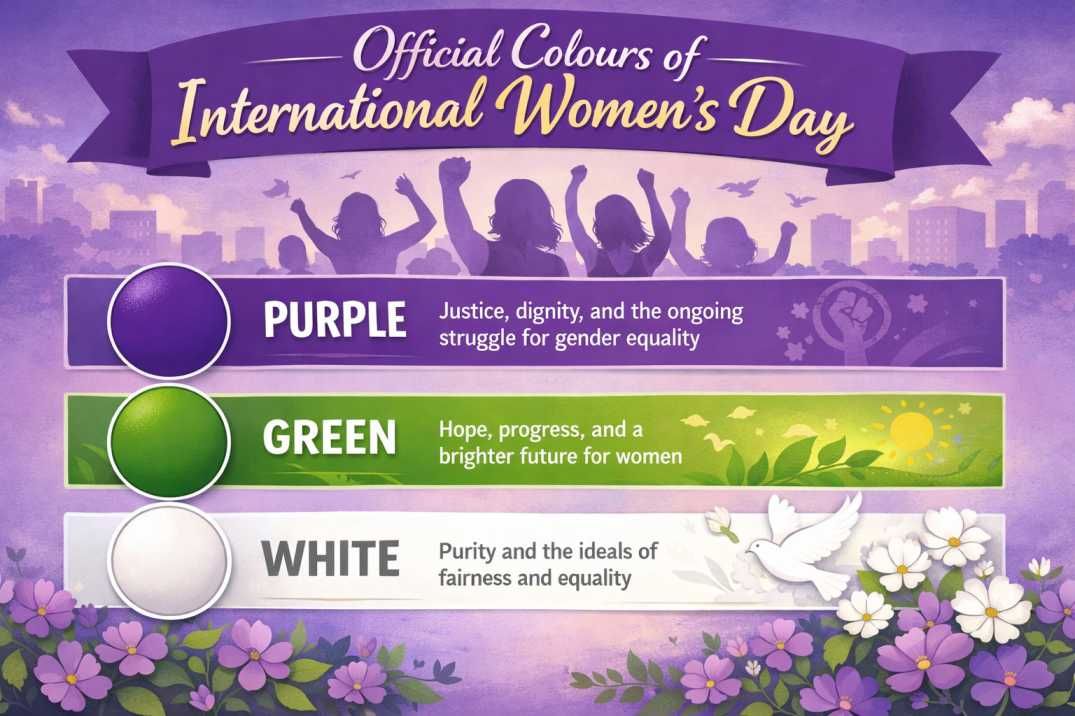
These colours were first adopted in the early 20th century by the Women's Social and Political Union (WSPU) in the United Kingdom, a prominent organisation of the British women’s suffrage movement that fought for women’s voting rights.
Over time, these colours were widely embraced during International Women’s Day celebrations across the world.
Key Facts About Women's Empowerment and Gender Equality
Below are important facts and statistics from global and Indian perspectives, presented in a student-friendly format.
1. Education and Literacy
- There were 12.9 million out-of-school girls globally in 2020, primarily due to poverty, early marriage, and lack of infrastructure
- Women account for nearly two-thirds of the world’s illiterate adult population, showing persistent gender gaps in education.
- Around 133 million girls worldwide are still out of school, mainly due to poverty, early marriage, and lack of infrastructure.
- Globally, adult female literacy reached about 86% in 2023, reflecting improvement compared to previous decades.
- Women represent over 50% of tertiary education students globally, but they remain underrepresented in STEM fields.
- Globally, the gender parity index (GPI) for primary education reached 0.97 in 2023, with 128 countries achieving a GPI of 1.0 or higher
2. Women in Science and Workforce
- Women constitute only about one-quarter of the world’s scientific researchers, highlighting gender imbalance in science and technology.
- The global gender wage gap (average) was 16% in 2023, meaning women earn 84 cents for every dollar earned by men, with a 35% gap in the Middle East and North Africa
3. Health and Social Development
- The global maternal mortality ratio (MMR) was 201 deaths per 100,000 live births in 2022, down from 329 in 2000, but 80% of deaths occur in sub-Saharan Africa
- 225 million women globally had an unmet need for family planning in 2023, with 53 million in sub-Saharan Africa
- Global HPV vaccination coverage among girls aged 15 was 81% in 2022, with 92% coverage in high-income countries and 53% in low-income countries.
4. Violence and Offences against Women
- 35% of women globally experienced physical domestic violence in their lifetime (2020), with 36% in high-income countries and 34% in low-income countries
- 19% of women globally experienced sexual violence by an intimate partner in their lifetime (2022), with 21% in high-income countries and 16% in low-income countries
- 177 countries globally had laws criminalising domestic violence in 2023, while 59 countries had no such laws
Conclusion
International Women's Day 2026 is a reminder that true progress is possible only when women and men move forward together as equal partners in development.
The way ahead lies in investing in girls’ education, ensuring equal opportunities in the workforce, strengthening legal protections, and encouraging women’s leadership in every sphere of society. Governments, institutions, and individuals all have a role to play in creating an environment where women can learn, lead, innovate, and inspire.
As we celebrate International Women’s Day 2026, the message is clear: when women rise, societies prosper.
Start your UPSC Preparation 2027 with SuperKalam
SuperKalam is your personal mentor for UPSC preparation, guiding you at every step of the exam journey. Practice, revise, and evaluate– all in one place.
Install Now