Why the 2026 Bill May Force a Rethink on Free UPI - UPSC Notes
Aug, 2026
•10 min read
Overview

Fig: India's UPI ecosystem faces a structural transition as legislative amendments re-examine the zero-MDR pricing regime.
India is moving away from state-subsidised payment expansion. The statutory removal of the zero-MDR mandate through the Taxation and Other Laws (Amendment) Bill, 2026 marks a shift toward a self-sustaining commercial framework. This structure balances payment service provider viability against merchant adoption without imposing fees on retail consumers.
Passed by Parliament in August 2026, the legislation amends the Payment and Settlement Systems Act, 2007 to enable regulated charges on high-value commercial transactions. With UPI processing over 23 billion transactions monthly, zero-MDR generated severe structural revenue deficits for acquiring banks and fintech applications.
While government subsidies offset initial setup expenses, growing fraud prevention demands durable revenue models. By distinguishing peer-to-person transfers from commercial transactions, the statute preserves zero-fee consumer access while letting payment intermediaries recover operational costs from large merchants. This grounds India's digital public infrastructure on long-term financial sustainability.
Why Free UPI is Facing a Policy Crossroads
India's flagship digital payments network faces a financial turning point as transaction volumes strain infrastructure.
As of August 2026, monthly operational data from the National Payments Corporation of India (NPCI) showed that Unified Payments Interface (UPI) transactions exceeded 23 billion in volume and Rs 29.9 lakh crore in value, accounting for nearly 88% of all digital payment volumes in India.
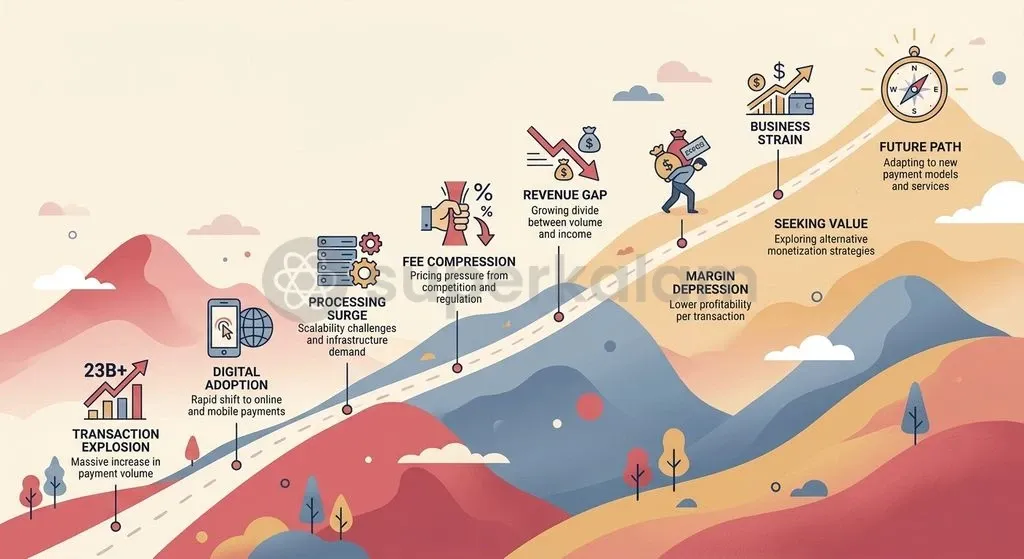
Fig: Rapid transaction volume expansion has amplified revenue deficits under the zero-MDR mandate.
However, a report presented by the Parliamentary Standing Committee on Finance in March 2026 highlighted that the zero-Merchant Discount Rate (MDR) regime causes an annual revenue loss of Rs 10,000 crore to Rs 12,000 crore for the digital payments industry.
Payment Service Providers (PSPs) and acquiring banks incur continuous operational costs across key areas:
- Server capacity: Expanding switch capacity to maintain uptime during traffic surges.
- Cyber security: Scaling real-time fraud monitoring and threat mitigation tools.
- Dispute resolution: Maintaining dedicated infrastructure for handling failed transactions.
Without a built-in commercial fee structure, financial institutions have struggled to maintain system uptime and scale anti-fraud mechanisms alongside rapid volume growth.
What the 2026 Bill Proposes for Digital Payments
The Lok Sabha passed the Taxation and Other Laws (Amendment) Bill, 2026 on August 6, 2026, amending Section 10A of the Payment and Settlement Systems Act, 2007.
According to Lok Sabha Proceedings, this legislative amendment officially removes the blanket statutory prohibition on charging Merchant Discount Rate (MDR) on UPI and RuPay card transactions.
In a clarifying speech in Parliament, Union Finance Minister Nirmala Sitharaman stated that any eventual MDR under the amended Act will apply strictly to commercial merchants and not to individual end-user consumers.
The policy framework being considered by the government outlines clear operational parameters:
- P2P Transfers: Individual peer-to-person (P2P) money transfers remain 100% free across the network.
- P2M Transactions: An MDR of 0.25% to 0.4% (and up to 0.5%) is likely permitted on peer-to-merchant (P2M) transactions exceeding Rs 2,000 for large merchants.
- Small Merchant Protection: Small businesses and low-value purchases remain protected under zero-fee structures.
Discuss with Superkalam
Recall the three key statutory provisions that operationalised the legal zero-MDR regime on January 1, 2020.
Ask NowHow the Zero-MDR Policy Shook Up the Ecosystem
The Central Board of Direct Taxes operationalised the zero-MDR framework on January 1, 2020, through a coordinated tripartite legal structure across statutory tax and payment laws.
This legal framework was anchored in Section 269SU of the Income-tax Act, 1961, Rule 119AA of the Income-tax Rules, and Section 10A of the Payment and Settlement Systems Act, 2007.
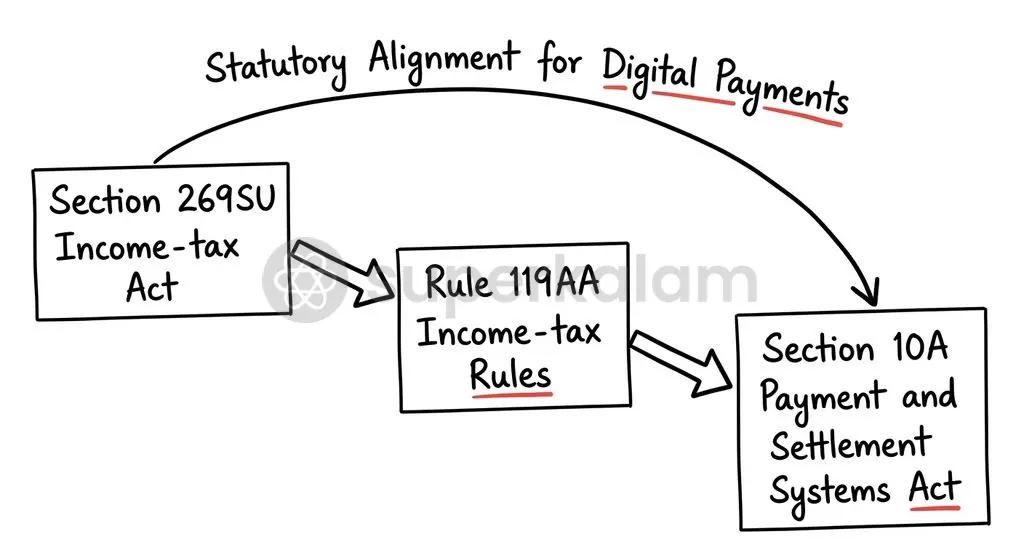
Fig: The statutory framework governing zero-MDR spanned tax laws and payment systems regulation.
While the statutory fee waiver accelerated merchant onboarding across Tier-2 and Tier-3 towns, it eliminated merchant fee income for acquiring banks, third-party app providers, and payment gateways.
| Dimension | Pre-2020 Framework | Zero-MDR Era (2020–2026) | Proposed 2026 Framework |
Statutory Mandate | Unregulated commercial MDR | Section 10A, Payment & Settlement Systems Act, 2007 | Amended Section 10A, P&SS Act, 2007 |
P2P Charges | Free / nominal bank charges | 100% Free | 100% Free |
P2M Charges | Uncapped commercial MDR | Zero MDR across all merchants | Regulated MDR for large merchants (>Rs 2,000) |
Industry Revenue | Merchant funded | Dependent on budget subsidies | Hybrid: Regulated merchant fees + targeted subsidies |
Ecosystem Viability | High bank margins, low adoption | High adoption, severe PSP revenue losses | Balanced sustainability and fraud prevention |
Lessons from the RBI Discussion Paper on Payment Charges
The Reserve Bank of India published its Discussion Paper on Charges in Payment Systems in August 2022, quantifying the underlying processing costs borne by payment intermediaries.
Data from the Reserve Bank of India (RBI) revealed that payment service providers incur processing costs averaging ~0.25% of transaction value for peer-to-merchant payments and ~0.125% for peer-to-person transfers at an average ticket size of Rs 800.
The central bank paper invited public feedback on introducing a tiered pricing model to ensure financial institutions recover operational expenses without discouraging micro-merchants:
- Micro-Transaction Protection: Keep small merchants and low-value transactions permanently exempt from transaction fees.
- Cost Recovery: Require larger commercial entities to bear regulated MDR charges to fund infrastructure reliability and digital security.
How NPCI Manages Costs and Subsidy Sharing
The National Payments Corporation of India instituted a targeted interchange fee framework in April 2023 to manage payment routing expenses on prepaid instruments.
According to NPCI circulars, an interchange fee of up to 1.1% was introduced on UPI merchant transactions exceeding Rs 2,000 conducted via Prepaid Payment Instruments (PPIs/wallets), effective April 1, 2023.
NPCI Operating Circular No. 164/2022-23 established tiered interchange charges based on merchant categories:
| Category | Interchange Fee Rate |
Fuel Payments | 0.5% |
Utilities, Telecom, and Education | 0.7% |
General Retail and Stores | 1.1% |
To support acquiring banks handling low-value merchant transactions, the Union Government allocated Rs 2,000 crore as incentive subsidy in Union Budget 2026-27 under Demand No. 27 of the Ministry of Electronics and Information Technology. This followed a Union Cabinet approval of Rs 1,500 crore for FY 2024-25 to compensate acquiring institutions at 0.15% per transaction for low-value P2M payments up to Rs 2,000.
Discuss with Superkalam
Can Singapore's ban on merchant payment surcharges be enforced effectively among India's micro-merchants?
Ask NowThe Economics of Free Transactions: Who Pays?
The Payments Council of India highlighted in February 2026 that public subsidy allocations fall short of meeting actual technology maintenance and fraud prevention costs.
A statement by the Chairman of the Payments Council of India (PCI) emphasised that the Rs 2,000 crore government subsidy in Budget 2026 is insufficient to cover industry infrastructure and cyber fraud mitigation requirements, advocating strongly for a regulated merchant-funded fee model.
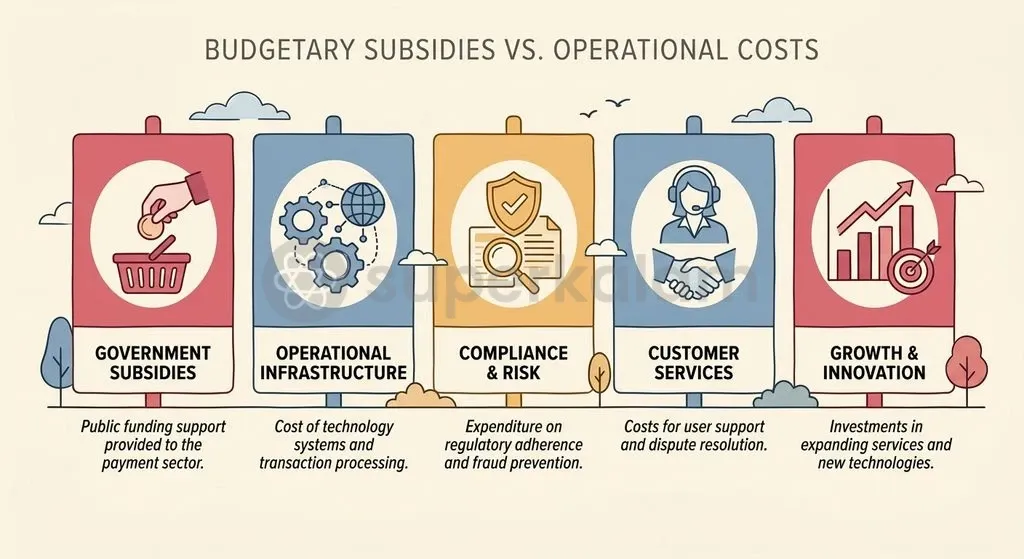
Fig: Budgetary incentive subsidies compensate acquiring institutions for only a fraction of total system maintenance costs.
When digital payment platforms operate under strict zero-MDR regimes, providers face systemic monetisation constraints:
- Cross-Subsidisation Reliance: Application providers attempt to offset core payment processing costs by selling peripheral hardware like soundboxes or offering high-yield loan distribution.
- Infrastructure Underinvestment: When secondary monetisation falls short, providers curtail investments in server redundancy, fraud monitoring, and dispute resolution.
- Systemic Vulnerability: Underfunding core operational controls introduces operational risks into the national payments grid.
Global Models: How Other Nations Price Instant Payments
International central bank frameworks show how regulated merchant fees preserve retail digital inclusion while funding infrastructure.
- Singapore (PayNow): Transfers remain free for retail consumers under Monetary Authority of Singapore guidelines, while merchants pay a fee of 0.65% to 0.9%. MAS rules strictly prohibit merchants from passing surcharges on to consumers.
- United Arab Emirates (Aani): The Central Bank of the UAE offers consumer transfers free up to AED 10,000. Under UAE Cabinet Resolution No. 176M/4M of 2026, federal fee collection integrated Aani with regulated institutional usage fees.
- European Union (Instant SEPA): Regulation (EU) 2024/886 mandates that instant transfer fees cannot exceed standard transfer charges. Providers had to enable receiving instant payments by January 9, 2025, and sending them with free Verification of Payee by October 9, 2025.
The Way Forward for Sustainable Digital Public Infrastructure
The Reserve Bank of India and Ministry of Finance must structure a balanced regulatory framework that preserves digital inclusion while enabling commercial sustainability.
- Tiered MDR Model: Establish a transparent fee structure that permanently exempts small merchants below prescribed annual turnover thresholds to protect micro-enterprises.
- Anti-Surcharging Enforcement: Enforce an explicit anti-surcharging regulation to prevent commercial establishments from passing merchant fees on to consumers.
- Dedicated Reinvestment: Mandate that acquiring banks channel a fixed share of merchant fee revenues directly into real-time fraud detection, server upgrades, and grievance resolution.
Key Takeaways
- The Taxation and Other Laws (Amendment) Bill, 2026 amends Section 10A of the Payment and Settlement Systems Act, 2007, removing the statutory zero-MDR prohibition on UPI and RuPay card transactions.
- Union Finance Minister Nirmala Sitharaman confirmed in Parliament that future MDR charges will apply strictly to merchants, ensuring person-to-person transfers remain completely free for retail consumers.
- The Parliamentary Standing Committee on Finance reported that the zero-MDR mandate inflicts an annual revenue loss of Rs 10,000 crore to Rs 12,000 crore on payment service providers.
- Central bank research in the RBI Discussion Paper indicates processing costs of ~0.25% for P2M transactions, supporting tiered MDR models where large merchants bear processing costs.
- International precedents from Singapore's PayNow, UAE's Aani, and EU Instant Payments Regulation prove that combining free consumer transfers with regulated merchant fees secures both digital inclusion and commercial viability.
Mains Question
"Cross-subsidisation reliance and secondary monetisation cannot substitute for core payment processing revenues in a maturing digital grid." Discuss how the proposed hybrid fee framework reconciles the financial viability of payment service providers with retail digital inclusion. (10 Marks)
Evaluate NowMultiple Choice Questions
QUESTION 1
Medium
Economy
Q1. Consider the following statements regarding the Taxation and Other Laws (Amendment) Bill, 2026 and its impact on digital payments in India:
- It amends Section 10A of the Payment and Settlement Systems Act, 2007 to remove the blanket statutory prohibition on charging Merchant Discount Rate (MDR) on UPI and RuPay card transactions.
- Under the proposed framework, individual peer-to-person (P2P) transfers will be subject to a mandatory fee of 0.25%.
- Small businesses and low-value purchases remain protected under zero-fee structures under the proposed parameters.
Which of the statements given above are correct?
Select an option to attempt
QUESTION 2
Economy
Q2. According to the report presented by the Parliamentary Standing Committee on Finance in March 2026, what was the estimated annual revenue loss incurred by the digital payments industry due to the zero-MDR regime?
Select an option to attempt
QUESTION 3
Medium
Economy
Q3. Regarding global regulatory models for pricing instant digital payments, consider the following statements:
- Under Monetary Authority of Singapore (MAS) guidelines for PayNow, merchants are explicitly permitted to pass payment surcharges directly on to consumers.
- Regulation (EU) 2024/886 mandates that instant transfer fees in the European Union cannot exceed standard transfer charges.
Which of the statements given above is/are correct?
Select an option to attempt
Related Blogs

FCRA Amendments 2026: Securitisation, Asset Custody & Civil Society Accountability - UPSC Notes
Aug, 2026
•10 min read

India's Military Theaterisation: Structural Challenges & Path Ahead - UPSC Notes
Aug, 2026
•12 min read

Sovereign AI and India's Digital Public Infrastructure - UPSC Mains Notes
Aug, 2026
•10 min read


