Inclusive Growth UPSC Notes: Definition, Objectives and Government Schemes
Dec, 2025
•4 min read
Inclusive Growth is one of the core themes of India’s development strategy and lies at the heart of the vision of the Indian Constitution's social and economic justice. It focuses on ensuring that the benefits of economic growth reach all sections of society, especially the poor, women, youth, and marginalised communities.
Inclusive Growth is an important topic for both Prelims (features, pillars, government schemes, indices) and Mains (role in poverty reduction, inequality, human development, and policy measures). Let’s study this topic in detail!
What is Inclusive Growth?
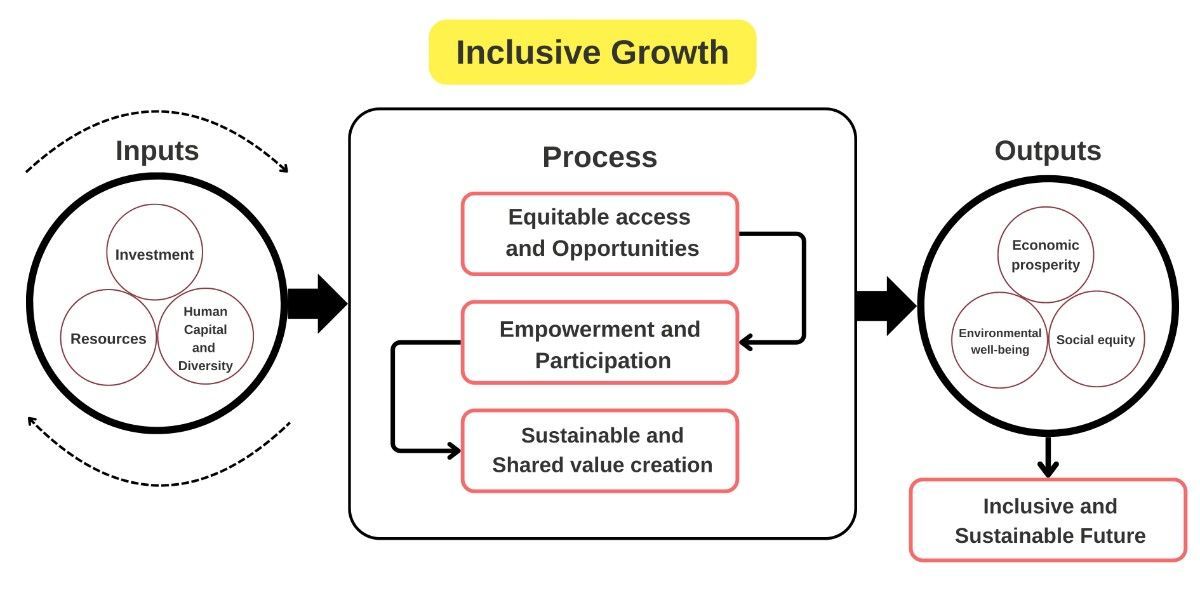
According to the United Nations Development Program (UNDP), Inclusive growth is the process and the outcome where all groups of people have participated in the organisation of growth and have benefited equitably from it.
In simple words, Inclusive growth means economic growth that benefits everyone in society, not just the rich and powerful. It is a growth that creates jobs, reduces poverty, and helps everyone, especially the poor and marginalised, to access basic services like education, healthcare, housing, and clean water.
- Inclusive growth works on the principle of "Sabka Saath, Sabka Vikas" (with everyone, for everyone's development).
- It is aligned with the UN's Sustainable Development Goals principle to ensure vulnerable groups benefit from growth.
- It promotes constitutional values of equity and fair opportunity for all citizens.
- Growth must occur not just in major cities but also in villages and small towns, across all regions.
- Every citizen should have fair access to resources, education, employment, and markets, regardless of their background.
- Strategies must specifically target uplifting the poorest sections and reducing income inequalities.
Also read: MSMEs in India UPSC Notes: Classification, Sectors and Government Schemes & Challenges
Objectives of Inclusive Growth
The primary objective of inclusive growth is to combine high economic growth with equity and opportunity for all.
- Poverty Reduction and Elimination: Reduce absolute and relative poverty across rural and urban areas.
- Income and Wealth Equalisation: Narrow the gap between the rich and the poor to create a more equal society.
- Employment Generation: Create sufficient, quality jobs across sectors and geographies to provide dignified livelihoods.
- Human Development: Improve health outcomes, literacy rates, skill levels, and overall human capital.
- Balanced Regional Development: Reduce disparities between developed and underdeveloped regions and states.
- Access to Basic Services: Ensure universal access to healthcare, education, sanitation, water, and electricity.
- Women and Youth Empowerment: Provide equal opportunities for women and youth to participate in economic and social life.
Also read: BharatNet Project | UPSC Governance Notes
Pillars of Inclusive Growth (Bharatiya Model)
The Government of India, through NITI Aayog, has developed a unique "Bharatiya Model” of Inclusive Growth, also called "Sabka Vikas." This model is built on three strong pillars that work together to create an inclusive, sustainable economy.
Pillar 1: Market Economy
This pillar emphasises that private enterprise, competition, and entrepreneurship are the main engines of growth and job creation.
- The private sector leads economic growth through business innovation and competition.
- Focus on "Minimum Government, Maximum Governance", the government does only what is necessary.
- Infrastructure development through public-private partnerships (PPP).
- Digital public goods like Aadhaar, UPI, and digital payment systems.
- Support for MSMEs, startups, and traditional businesses through credit and skilling.
- Trade liberalisation and attracting foreign investment.
Pillar 2: Antyodaya and Empowerment
This pillar focuses on uplifting the most disadvantaged members of society and empowering everyone to reach their full potential. "Antyodaya" means "uplift of the poorest and weakest."
- Direct welfare support through cash transfers and in-kind benefits.
- Healthcare, education, housing, food security, and clean energy for the poor.
- Women and youth empowerment programs.
- Gender equality initiatives and protection of vulnerable groups.
- Social safety nets during emergencies and natural disasters.
- Community participation in local governance through Gram Sabhas and Panchayats.
Pillar 3: Holistic and Pragmatic Approach
This pillar emphasises that economic decisions must be based on real evidence, ground experience, and India's unique context, not just ideology or foreign models.
- Flexible monetary policy is balanced between inflation control and growth.
- Focus on macroeconomic stability (low inflation, strong currency, fiscal discipline).
- Green economy initiatives for sustainable development.
- Pragmatic policy-making with feedback loops for continuous improvement.
- Integration of all government programs for maximum impact.
- Coordination between different government agencies and departments.
Also read: PM Gati Shakti National Master Plan: Government Scheme for UPSC
Key Measures to Promote Inclusive Growth in India
The Government of India implements a wide range of programs and schemes to ensure inclusive growth reaches every citizen. Let us explore the major categories of initiatives.
A. Employment and Livelihood Generation
The government ensures that everyone has the opportunity to earn a living through meaningful work.
1. Mahatma Gandhi National Rural Employment Guarantee Act (MGNREGA)
- Guarantees 100 days of wage employment per year to rural households.
- At least one-third of jobs are reserved for women.
- Wages are paid in accordance with the minimum wage rates.
2. PM Kaushal Vikas Yojana (PMKVY)
- Free skill training for youth to become employable.
- Industry-aligned skills through certified training programs.
- Monetary awards upon successful completion of training.
B. Education and Skill Development
Quality education is the foundation of inclusive growth. The government ensures every child gets access to education.
1. Right to Free and Compulsory Education Act (RTE), 2009
- Guarantees free education to all children aged 6-14 years.
- Makes primary and upper primary education a fundamental right.
- Promotes inclusive education for children with disabilities.
2. Scholarship Programs
- Financial aid for underprivileged students pursuing higher education.
- Special scholarships for SC/ST/OBC students.
- Merit-cum-means scholarships for talented yet financially disadvantaged students.
C. Healthcare and Nutrition
Good health is essential for people to participate in economic activities and improve their quality of life.
1. Ayushman Bharat - Pradhan Mantri Jan Arogya Yojana (PM-JAY)
- World's largest health insurance scheme.
- Provides health cover of ₹5 lakh per family per year.
- Covers secondary and tertiary hospitalisation.
2. National Health Mission (NHM)
- Ensures universal access to equitable and quality healthcare.
- Strengthens public health infrastructure.
- Focuses on maternal and child health.
- Expands healthcare services to rural and remote areas.
3. Pradhan Mantri Suraksha Bima Yojana (PMSBY)
- Accident insurance scheme for informal sector workers.
- Provides ₹2 lakh coverage for accidental death or disability.
- Premium: Only ₹12 per year.
D. Financial Inclusion
When people have access to banking and credit, they can invest, save, and improve their economic situation.
1. Pradhan Mantri Jan Dhan Yojana (PMJDY)
- Provides zero-balance bank accounts to every unbanked adult.
- World's largest financial inclusion initiative.
- Includes a free RuPay debit card with insurance cover of ₹2 lakh.
- Overdraft facility up to ₹10,000 for emergencies.
2. Pradhan Mantri Mudra Yojana (PMMY)
- Microfinance scheme for small entrepreneurs.
- Loans up to ₹10 lakh without collateral.
- Three loan categories for different business stages.
E. Housing and Basic Infrastructure
Safe shelter is a basic need. The government ensures everyone has access to decent housing.
1. Pradhan Mantri Awas Yojana (PMAY)
- Provides affordable housing to economically weaker sections and low-income groups.
- Urban component: Interest subsidy on home loans for poor families.
- Rural component: Direct assistance to construct pucca (permanent) houses.
2. Swachh Bharat Mission
- Provides toilets and sanitation facilities to every household.
- Significant improvement: Rural sanitation coverage increased dramatically.
- Focus on behaviour change for sustainable sanitation practices.
- Created job opportunities for sanitation workers.
F. Food Security and Nutrition
Nobody should go hungry or face food insecurity. The government ensures affordable food access.
1. National Food Security Act (NFSA), 2013
- Legal right to food for two-thirds of India's population.
- The Public Distribution System (PDS) provides subsidised rice, wheat, and grains.
- Women household heads get priority as ration card holders.
2. Direct Benefit Transfer (DBT) to Farmers
- Cash support to farmers during planting and harvesting.
- Reduces dependence on middlemen and informal lending.
- Enables farmers to buy quality seeds and fertilisers.
3. Mid-Day Meal Scheme
- Free nutritious meals for school children.
- Improves school attendance and learning outcomes.
- Addresses malnutrition in children.
- Now expanded as PM-Poshan.
G. Women Empowerment and Gender Equality
Empowering women creates a more inclusive and dynamic society.
1. Beti Bachao, Beti Padhao (BBBP)
- A campaign to improve the girl child sex ratio and education.
- Addresses gender-biased sex selection.
- Ensures girls get quality education and healthcare.
- Improved sex ratio and school enrollment of girls.
- Increased institutional deliveries and healthcare access.
2. Sukanya Samridhi Yojana
- Savings scheme for girls' education and marriage.
- Tax benefits and high interest rates.
- Encourages savings for girls' future.
Also read: Unemployment in India UPSC Notes: Types, Causes & Government Measures
Policy Measures for Inclusive Growth in India
Beyond individual schemes, the Government of India has adopted comprehensive policy frameworks to promote inclusive growth.
- Constitutional Framework: Fundamental Right to Equality, Directive Principles emphasising welfare, Right to Free and Compulsory Education, Provisions for SC/ST/OBC protection.
- Five-Year Plans: 11th and 12th Five-Year Plans explicitly focused on Faster, Sustainable, and More Inclusive Growth, 26 monitorable targets for inclusion, and focused on employment, poverty reduction, and inequality.
- New India @75 Vision (NITI Aayog): Long-term strategy for inclusive and sustainable growth, Objectives for rapid growth reaching 9-10%, clean growth, inclusive development, and inclusive urban development for poor and slum dwellers.
- Goods and Services Tax (GST): Unified indirect tax system reducing compliance burden, creates a formal economy by making informal sector registration easier, Transparency and accountability in tax collection.
- Labour Code Reforms: Consolidation of multiple labour laws into four codes, Simplified compliance for employers, Better worker protection and social security, Formalisation of the informal sector workforce.
- Public-Private Partnership (PPP) Framework: The Government encourages private sector participation in infrastructure, unbundling of infrastructure for private management, and competitive bidding ensures efficiency and cost-effectiveness.
UPSC Prelims PYQ on Inclusive Growth
QUESTION 1
Easy
Economy
Prelims 2010
Inclusive growth as enunciated in the Eleventh Five Year Plan does not include one of the following
Select an option to attempt
Factors Affecting Inclusive Growth in India
Despite significant progress, numerous structural and systemic factors continue to challenge inclusive growth in India.
- Income and Wealth Inequality: Wealth is concentrated among a few, while the majority remains poor, preventing equitable distribution of growth benefits and limiting economic opportunities for common people.
- Unemployment and Informal Workforce: A large informal workforce without job security, social benefits, or formal banking access perpetuates poverty and prevents inclusive economic participation.
- Gender Inequality: Social discrimination and safety concerns keep women out of formal employment, excluding half the population from meaningful economic contribution.
- Rural and Urban Divide: Rural areas lack basic infrastructure like electricity, healthcare, and education, creating massive regional disparity and forcing migration to cities.
- Education and Skill Deficit: Wide educational disparities between regions and communities, high dropout rates, and skill mismatch prevent youth from accessing better opportunities.
- Implementation Gaps: Corruption, weak monitoring, and poor implementation prevent welfare schemes from reaching intended beneficiaries and exclude marginalised communities.
UPSC Mains Previous Year Question
Is inclusive growth possible under market economy ? State the significance of financial inclusion in achieving economic growth in India. (2022)
Evaluate Your Answers nowWay Forward
“When everyone is included, everyone wins.”- Jesse Jackson
For growth to be truly inclusive, India must consolidate its achievements while actively addressing the gaps that persist. Some key focus areas include:
- Promote labour-intensive sectors like MSMEs and agriculture.
- Strengthen school quality and skill-based training.
- Invest in primary healthcare and child nutrition.
- Target infrastructure in backward and aspirational districts.
Start Your UPSC Preparation with SuperKalam
SuperKalam is your AI-powered personal mentor, keeping your preparation disciplined, focused, and effective with:
- Instant Mains answer evaluation
- Instant doubt resolution
- Personalised guidance
- Unlimited MCQs and PYQs
- Progress tracking through daily goals, streaks, and leaderboards.